 Starter motor & alternator specialist
 Truck and van parts
 New parts with a 2-year warranty

 Contact an expert


Tractor starter that clicks, cranks slowly or does nothing: how to check battery, cables and control, what can be repaired (solenoid, brushes, drive) and how to choose a compatible starter.
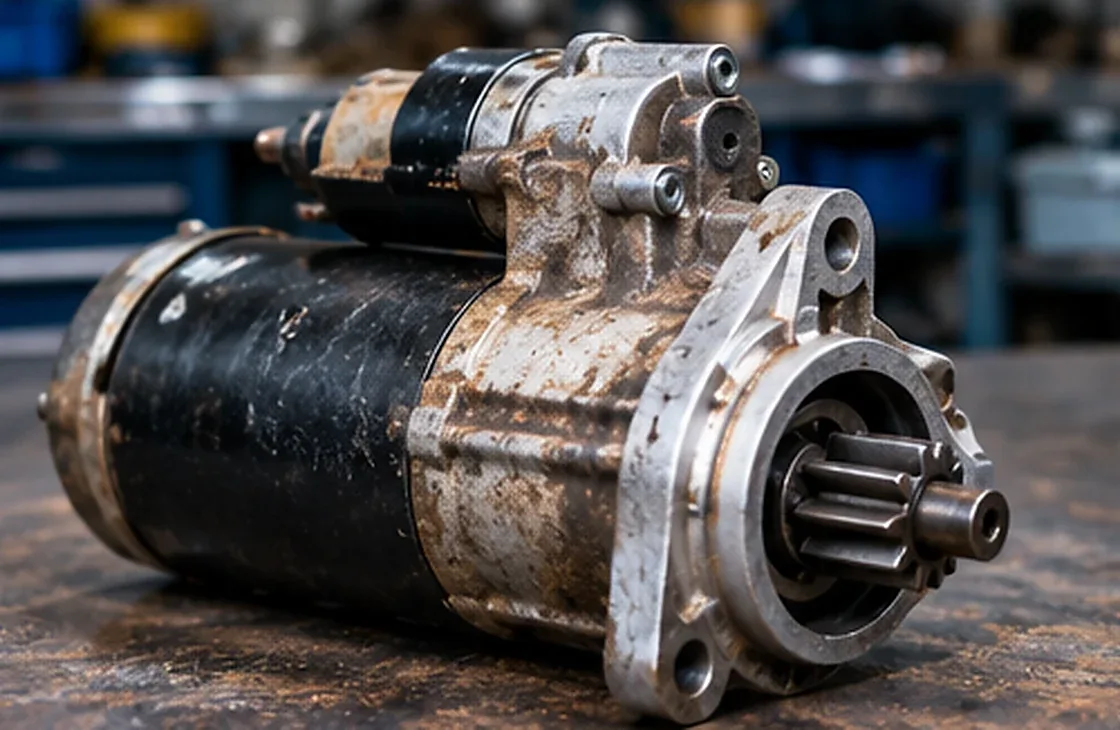
A tractor starter that clicks, cranks slowly or does nothing at all does not necessarily need replacing. On farm machinery, especially older tractors, the battery, cables, earth and starting interlocks are often to blame before the starter itself. Here is how to narrow it down, what can be repaired and how to choose the right part when replacement is unavoidable.
Key points
- Always check the battery under load and the voltage drops before removing the starter.
- On a 12 V circuit, the voltage should not fall below about 9.6 V while cranking.
- Solenoid, brushes, drive and bushes can be replaced on many models; a burnt armature or winding justifies a complete starter.
- To order, start from the number stamped on the starter and the engine type, not just the tractor model.
Which symptoms point to a starter problem?
What happens when you try to start points to the right lead:
| Symptom | Possible causes | First check |
|---|---|---|
| One clunk, no rotation | Insufficient voltage, earth, solenoid contacts | Battery under load, connections |
| Repeated clicking | Flat battery, poor contact | Voltage while trying to start |
| Very slow cranking | Tired battery, resistive cables, internal wear, thick oil | Battery under load, voltage drops |
| Starter spins freely | Drive, freewheel, pinion or ring gear | Mechanical inspection, stop trying |
| No reaction | Starting interlock, relay, fuse, control | Neutral, PTO, control voltage |
| Grinding | Pinion not engaging properly, damaged ring gear | Stop and have it inspected |
Why won’t a tractor starter turn any more?
A weak or poorly charged battery
A battery can show about 12.6 V at rest and collapse as soon as the starter draws current. Only a load test reveals it. Also check that the alternator or dynamo is charging properly.
A corroded earth or cables
Loose terminals, a corroded engine-to-chassis earth strap, a cable reworked during an old repair: on a tractor that is several decades old, this is a very common cause of slow cranking.
A tired solenoid
The clunk shows it is reacting, not that its power contacts are passing current. Worn contacts give a starter that clicks without turning, especially when hot.
Worn brushes, commutator or bushes
The starter lacks torque and turns slowly or unevenly. The diagnosis is confirmed on a test bench.
A damaged drive or ring gear
The starter spins without turning the engine, or grinds. Persisting damages the flywheel ring gear, which is far more costly to replace.
For the frequent cold-weather cases and starters that spin freely, see tractor cranking slowly in winter and starter spinning freely.
How do you check the circuit with a multimeter?
Before any test: tractor on level ground, parking brake on, gearbox in neutral, PTO disengaged, nobody near moving parts.
- Identify the voltage: 12 V on the vast majority of tractors, 24 V on some large models. Some vintage tractors have been converted from 6 V to 12 V.
- Inspect terminals, overheated cables, damaged insulation and earth points.
- Measure the battery at rest: about 12.6 V for a charged 12 V battery.
- Measure while cranking: below about 9.6 V, the battery or the circuit is not delivering enough.
- Measure the voltage drops under load, between the battery + terminal and the starter power terminal, then between the battery – terminal and the starter housing. More than 0.5 V on the positive side or 0.3 V on the earth side indicates a connection to rework.
- Check the control: with no voltage on the control terminal when starting, look upstream (ignition switch, relay, neutral safety switch).
Never bridge the starter terminals with a screwdriver: the tractor can move if a gear is engaged, and the current causes arcing and burns.
Which starter parts can be replaced?
On many models, an equipped workshop can replace:
- the solenoid, when it no longer engages or passes current;
- the brushes and brush holder;
- the drive and its freewheel;
- the bushes or bearings if there is play;
- internal connections or contacts.
Repair is worthwhile if the armature, windings and housing are sound. When several parts are worn or the starter has overheated, complete replacement is often more reliable and quicker. The details are explained in solenoid, brushes or complete starter.
How do you choose a replacement starter?
The same tractor model often received several starters depending on year, engine and market. Check:
- the number stamped on the starter (Bosch, Valeo, Iskra, Magneti Marelli, Lucas, Delco Remy, Paris-Rhône…);
- the voltage and power in kW;
- the number of teeth and pinion diameter;
- the mountings, spigot diameter and direction of rotation.
On older tractors, a modern gear-reduction starter often replaces the old direct-drive unit, with an identical fitment. See starter motor for an old tractor and gear-reduction starters for tractors.
After fitting: the checks
Clean the earth surfaces, tighten the cables to the specified torque and check the battery. A new starter that clicks or turns poorly almost always points to a supply problem that is still there: see new starter not working after fitting.
Frequently asked questions
Can you start a tractor by tapping the starter?
It may free worn brushes for a while, but it is a stopgap that signals imminent failure. Plan the repair or replacement.
How long can you operate the starter?
A few seconds per attempt, then a pause to let it cool. Prolonged cranking destroys the starter and drains the battery.
Is a more powerful starter suitable?
Yes, with an identical fitment (mountings, pinion, direction of rotation): it will crank the engine better in cold weather.
For the charging circuit on vintage tractors, see also vintage tractor alternator: D+, W terminals and regulator.
Find the right part
AutoTruck42, a French company based in the Loire, supplies new starters with a 2-year warranty for old and recent tractors, as well as spare parts:
- Starters for agricultural tractors
- Starter spare parts
- Alternators for tractors and farm machinery
- All new starters
Send us the number or photos of your starter: we check compatibility before dispatch.
Further reading
- Faulty starter motor: symptoms, checks and choosing the right part number
- Tractor alternator overheating or dirty: belt, dust and oil leaks
- Starter failing when hot but working when cold: why?
- Diesel hard to start when cold: starter, battery or glow plugs?
- JCB, Case backhoe loader starter: Perkins engine, part number and equivalence
- Starter replacement cost: understanding a quote (car, van, machinery)
Browse our catalogue of car and truck parts.