 Starter motor & alternator specialist
 Truck and van parts
 New parts with a 2-year warranty

 Contact an expert


The engine starts fine in the morning but not after a drive: worn bushes, cable resistance, solenoid or exhaust heat. The causes of a starter that fails when hot and how to check them.
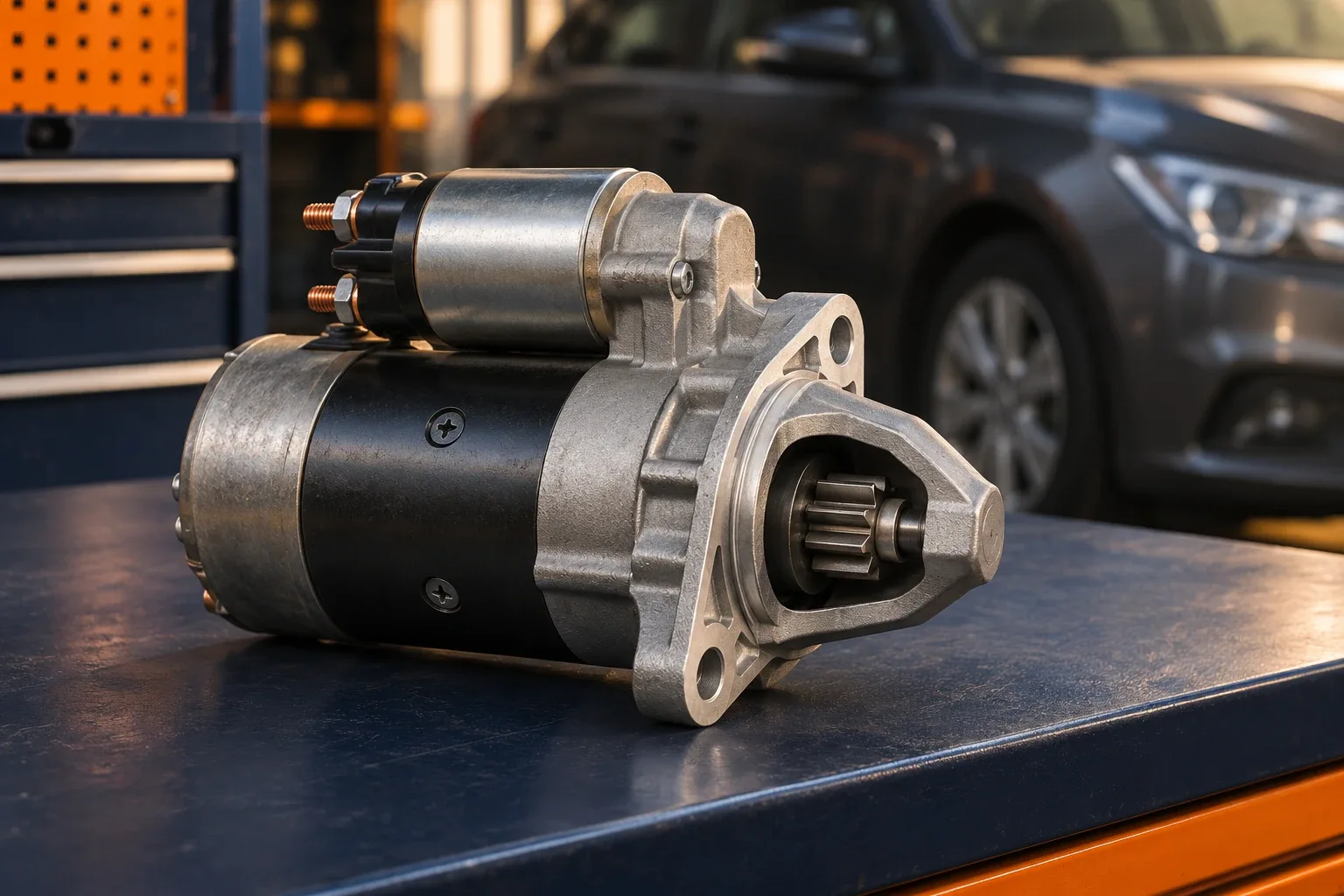
In the morning the engine starts without trouble. After a drive or a short stop, the starter clicks, cranks slowly or does nothing, then everything is normal again once the engine has cooled. This symptom is typical of a tired starter or a circuit whose resistance rises with heat. Here are the causes and how to check them.
Key points
- Heat expands parts: worn bushes let the armature rub, which then draws too much current.
- The electrical resistance of cables, terminals and windings rises with temperature.
- A starter fitted near the exhaust or turbo ages faster, especially without a heat shield.
- Measuring voltage at the starter with a hot engine separates a wiring fault from a worn starter.
Why heat makes the starter fail
When the engine is hot, so is the starter, sometimes above 100 °C if it is close to the exhaust. Already worn armature bushes let the shaft rub against the pole shoes. Hot windings resist current more, and the solenoid struggles to close its main contact. The starter then draws more current than the battery and cables can supply.
Causes to check
| Cause | Clue |
|---|---|
| Worn armature bushes | Slow cranking when hot, audible rubbing |
| Pitted solenoid contacts | Click without rotation, especially when hot |
| Corroded cable or terminal | Cable hot to the touch after the attempt |
| Tired engine earth | Lights dim heavily when starting |
| Starter close to the exhaust | Heat shield missing or damaged |
| Tired battery | Slow starting both cold and hot |
The hot-engine check
- Run the engine up to normal temperature, then switch it off.
- Measure battery voltage during the start attempt: it should not drop below 9.6 V on 12 V.
- At the same time, measure voltage on the starter’s main terminal.
- If the difference exceeds 0.5 V, check the positive cable, terminals and earth.
- If voltage at the starter is correct but it cranks slowly or clicks, the starter is worn.
Solutions
- Clean and tighten terminals, replace a tired earth strap.
- Replace a positive cable whose insulation has baked or that heats up.
- Refit or add the starter heat shield.
- Replace the starter if the bushes or solenoid are worn: a new starter fixes the problem for good.
Further reading
If the starter clicks without turning even when cold, read starter clicks but will not turn. Diesel engines, harder to crank, make the problem worse: see diesel cold starting. For hard-working vans, see Master, Ducato, Transit, Sprinter van starter. And to choose between repair and replacement: solenoid, brushes or complete starter.
Frequently asked questions
Why does my starter only work when cold?
Heat increases electrical resistance and internal friction in a worn starter. It no longer delivers enough torque when hot.
Is it the battery or the starter?
If cold starting is normal, the battery is rarely the only cause. Measure voltage at the starter with a hot engine to decide.
Is a heat shield enough?
It protects the starter and extends its life, but does not repair a starter that is already worn.
Find the right part
AutoTruck42, a French company based in the Loire, supplies new starter motors with a 2-year warranty for cars, vans, trucks, machinery and tractors:
- Starter motors for cars and vans
- 24 V starter motors for trucks and machinery
- Starter motors for tractors
Send us your starter part number or vehicle details: we check compatibility before dispatch.
Further reading
Browse our catalogue of car and truck parts.