 Starter motor & alternator specialist
 Truck and van parts
 New parts with a 2-year warranty

 Contact an expert


You have just fitted a new starter and it will not turn, clicks or grinds? Battery, wiring, command wire, earth, shims, ring gear: the checks to make before concluding the part is faulty.
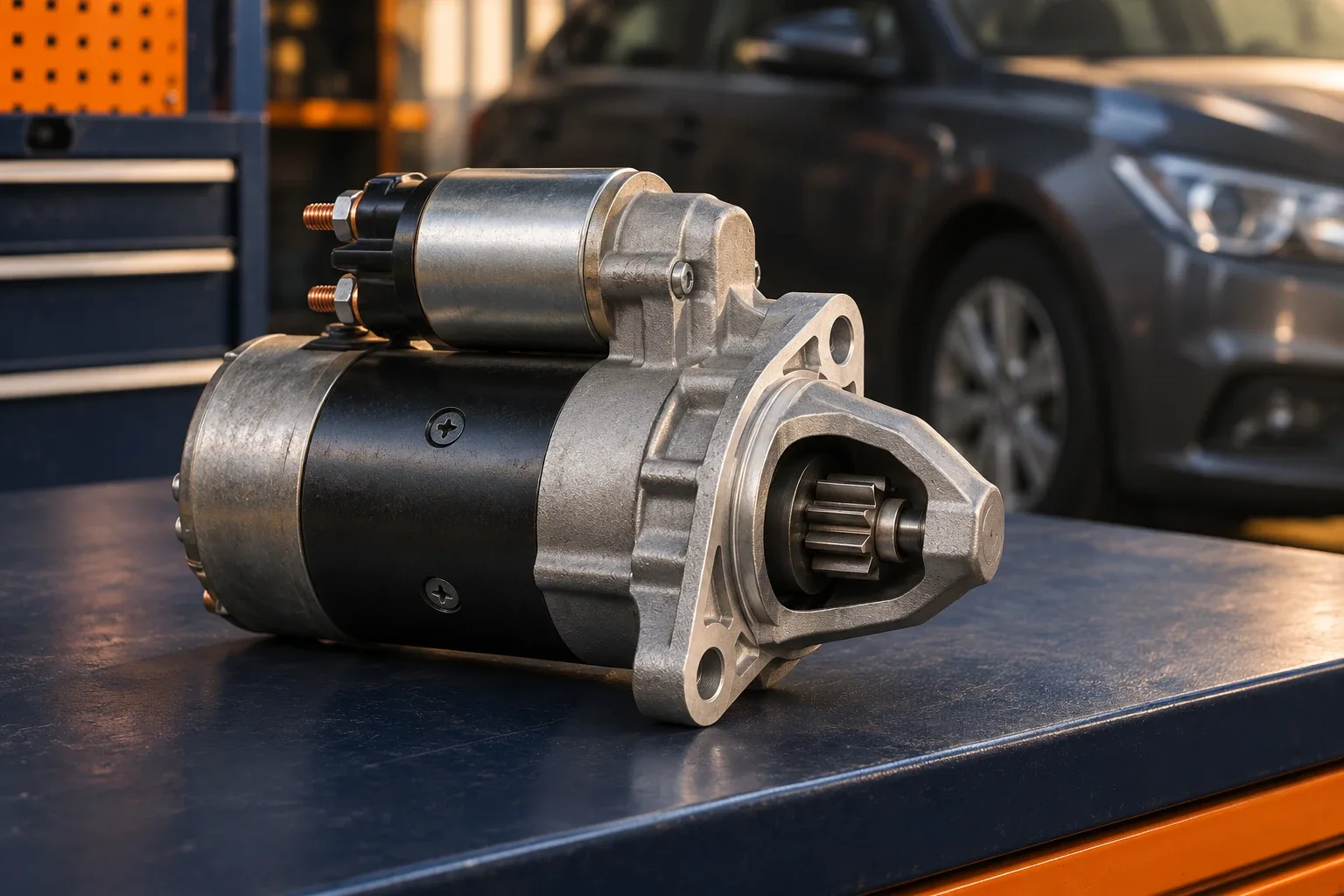
A new starter that does not work right after fitting is very rarely faulty. In most cases the cause lies around it: weak battery, loose cable, command wire swapped or not connected, poor earth, or a damaged flywheel ring gear. Here are the checks to make before returning the part.
Key points
- First compare the fitted part number with the old one: pinion, mounting, terminals and direction of rotation.
- A weak battery or loose terminals stop a new starter from turning.
- The command wire (terminal 50) must receive voltage when the starter is operated.
- If the pinion grinds, check the flywheel ring gear and the starter’s position.
Checks in order
- Measure the battery at rest: at least 12.4 V (or 24.8 V on 24 V).
- Check the main terminal (30) and battery terminal are tight.
- Check the engine-to-body or engine-to-chassis earth.
- Measure voltage on the command terminal (50) when the key or button is operated.
- Measure voltage on terminal 30 during the attempt: it should stay close to battery voltage.
- If all is correct and the starter does not turn, contact your supplier with your readings.
The most common causes
| Symptom | Common cause |
|---|---|
| No sound | Command wire not connected, relay, fuse, safety switch |
| Click without rotation | Weak battery, loose terminal, poor earth |
| Slow cranking | Weak battery, undersized or corroded cable |
| Grinding, catching | Damaged ring gear, wrong pinion, forgotten shim |
| Starter stays engaged | Command wire permanently live, faulty switch |
Fitting mistakes to avoid
- Swapping the command wire with another wire on the solenoid.
- Forgetting an adjustment shim present on the old starter.
- Leaving paint or rust on the mating face, which harms the earth.
- Under-tightening the terminal 30 nut.
- Fitting a starter whose pinion or direction of rotation differs from the original.
Checking compatibility
Before fitting, compare the old and new starters side by side: number of teeth, flange position, terminals and connector. For stop-start vehicles, make sure the part is a suitable model: see stop-start starter. For trucks and machinery, equivalence criteria are covered in 24 V starter: power, teeth, equivalence. The same reasoning applies to alternators: new alternator not charging.
If the starter grinds or spins freely
Grinding on starting with a new part often means a worn flywheel ring gear or a pinion that differs from the original. A new starter that spins freely may also indicate poor engagement due to incorrect mounting or shimming. The detailed diagnosis is in starter spinning freely. For a click without rotation: starter clicks but will not turn.
Frequently asked questions
My new starter will not turn, is it faulty?
Rarely. First check the battery, terminals, earth and command wire. A faulty new part is the exception.
The new starter stays engaged after starting, why?
The command wire stays live: check the switch, relay or wiring immediately to avoid damaging the starter.
Is a shim needed to fit the starter?
Only if the old one had one or the manufacturer specifies it. Always refit shims found on removal.
Find the right part
AutoTruck42, a French company based in the Loire, supplies new starter motors with a 2-year warranty for cars, vans, trucks, machinery and tractors:
- Starter motors for cars and vans
- 24 V starter motors for trucks and machinery
- Starter motors for tractors
New starter still not working after these checks? Contact us with the part number and your readings: our technicians will help you find the cause.
Browse our catalogue of car and truck parts.