 Starter motor & alternator specialist
 Truck and van parts
 New parts with a 2-year warranty

 Contact an expert


You have just fitted a new alternator and the light stays on or voltage will not rise? Excitation, connector, LIN control, earth, belt: the checks to make before concluding the part is faulty.
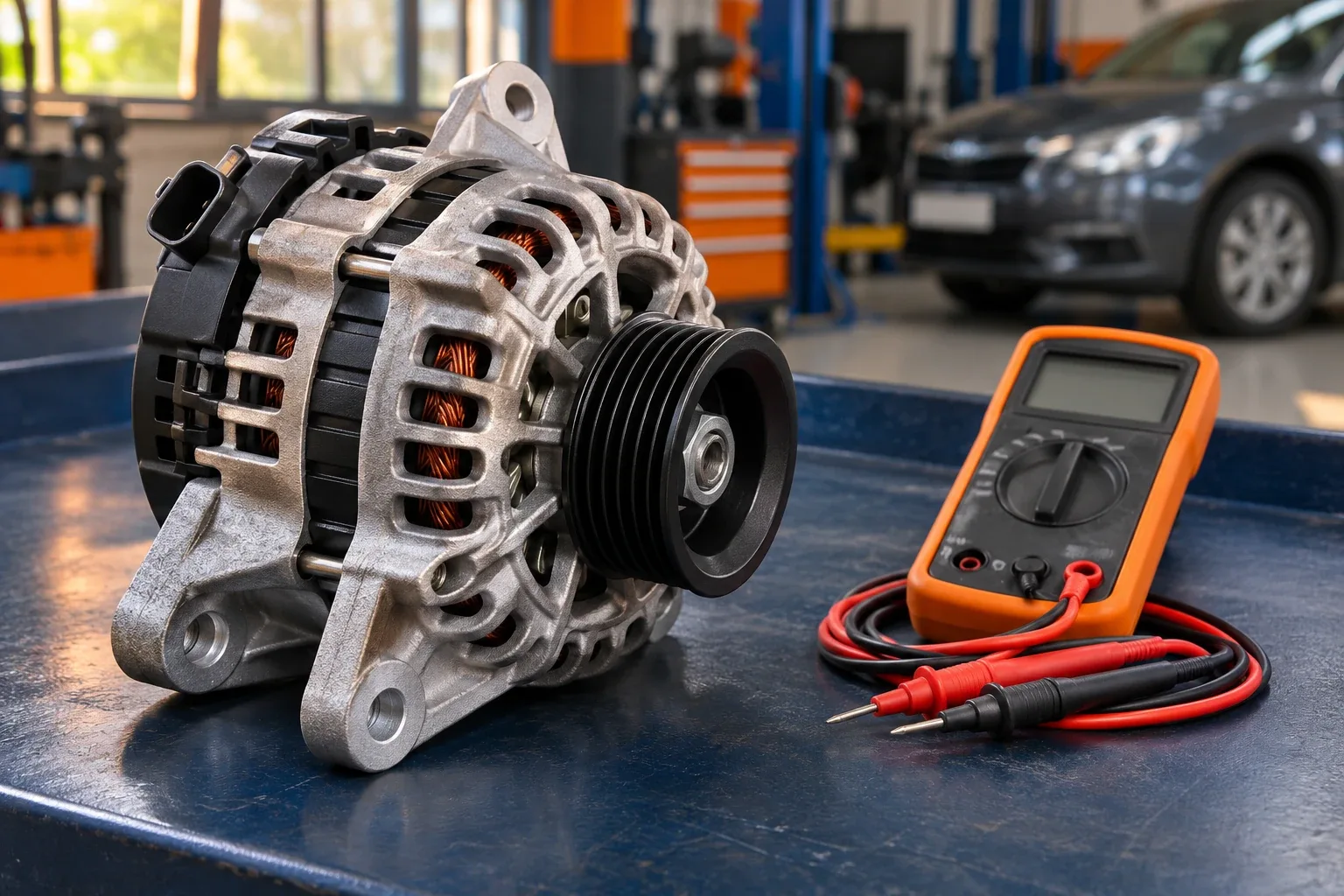
A new alternator that does not charge right after fitting is rarely faulty. In most cases the cause is external: excitation wire not connected, different connector, control by the ECU, poor earth or a dead battery. Here are the checks to make, in order, before returning the part.
Key points
- First check that the fitted part number exactly matches the old one: connector, number of pins and regulation type.
- Without an excitation signal (D+, L or ECU command), an alternator will not self-excite.
- Controlled alternators (LIN, COM, BSS, RLO) will not charge if the protocol does not match the vehicle.
- A dead battery or loose engine earth gives the same symptoms as a faulty alternator.
Checks in order
- Compare the old and new alternator: connector, pins, pulley, amperage.
- Measure battery voltage engine off: below 12.4 V, recharge or test the battery first.
- Check the B+ nut is tight and the terminal is clean.
- Check the engine-to-body earth and the battery earth.
- Ignition on, engine off, the charge light should come on: if not, the excitation circuit is open.
- At 1,500 rpm, measure voltage: 13.8 to 14.6 V on 12 V, 27.6 to 28.8 V on 24 V.
The most common causes
| Cause | Symptom | Check |
|---|---|---|
| D+ or L wire not connected | Light off with ignition on, no charging | Voltage on the wire with ignition on |
| Wrong control type | No charging, engine fault sometimes logged | Compare protocol (LIN, COM, BSS…) |
| Different connector | Plug forced or not connected | Number and shape of pins |
| Faulty earth | Weak charging, dim light | Earth voltage drop |
| Slack belt | Squeal, irregular charging | Belt tension and condition |
| Dead battery | Voltage collapses on cranking | Battery test |
Controlled alternators
On many recent vehicles, the ECU controls the alternator through a LIN or COM link. An alternator with a different protocol or control code will not charge, even if it fits perfectly. Compatibility is checked with the original part number: see LIN/COM controlled alternator compatibility. On some vehicles, an adaptation or fault clearing is also required after replacement.
Before returning the alternator
Measure voltage with a multimeter following testing a 12 V alternator with a multimeter. If the light stays on while driving, also see battery light on while driving. And if the battery drains overnight, the cause may be a parasitic drain: see battery draining overnight. The same reasoning applies to starters: new starter not working.
Frequently asked questions
My new alternator is not charging, is it faulty?
Rarely. First check excitation, connector, earth, belt and battery. A faulty new part is the exception.
Is programming needed after changing the alternator?
On some vehicles with a controlled alternator, yes: fault clearing or an adaptation with a diagnostic tool may be required.
The light no longer comes on at all with ignition on, what should I check?
The D+ or L excitation wire, the circuit fuse and the warning lamp or display.
Find the right part
AutoTruck42, a French company based in the Loire, supplies new alternators with a 2-year warranty for cars, vans, trucks and machinery:
- All new alternators
- Alternators for cars and vans
- Alternators for trucks and machinery
- Alternator spare parts
New alternator still not charging after these checks? Contact us with the part number and your readings: our technicians will help you find the cause.
Further reading
Browse our catalogue of car and truck parts.