 Starter motor & alternator specialist
 Truck and van parts
 New parts with a 2-year warranty

 Contact an expert


A battery warning light that comes on while driving signals a charging fault. What to do at the time, which causes to look for (belt, pulley, connection, regulator) and how to confirm the fault before buying.
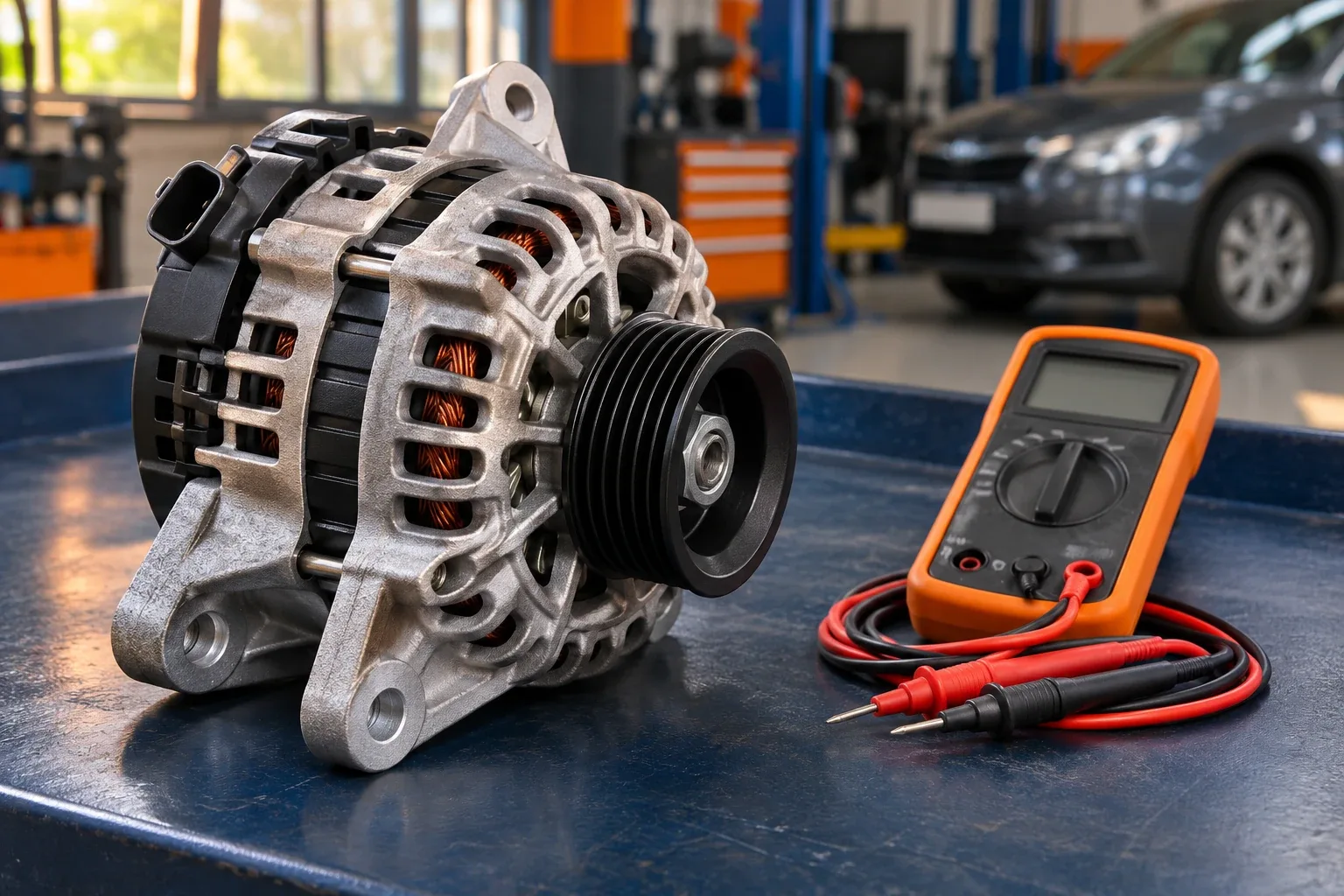
A battery light that comes on while driving does not mean the battery needs replacing: it shows that the charging circuit is no longer charging properly. The alternator, belt, a connection or the control may be at fault. Here is what to do at the time, then how to find the cause before buying a part.
Key points
- With the engine running, this light signals a charging fault: the battery is draining and the vehicle will eventually stop.
- If the steering becomes heavy or the engine temperature rises, the belt has probably snapped: stop immediately.
- Check the belt and connections first, then measure the charging voltage (about 13.5 to 14.8 V on a 12 V circuit).
- An intermittent light often comes from a connection, a slipping belt or worn brushes.
What should you do when the light comes on while driving?
- Switch off non-essential loads: blower, demister, heated seats, radio.
- Watch the engine temperature and the steering: if either changes, the accessory belt is probably at fault, stop safely.
- Get to a workshop without switching the engine off if possible: restarting will draw on an already weakened battery.
- Note the circumstances: engine speed, rain, headlights on, any noise.
What are the possible causes?
| Cause | Clue | Check |
|---|---|---|
| Broken or slack belt | Whine, heavy steering, rising temperature | Inspection with engine off, belt tension |
| Faulty overrunning pulley or idler | Noise, vibration, light at idle | Turn by hand with engine off |
| Corroded B+ or earth connection | Intermittent light, after washing or rain | Tightness and condition of terminals |
| Worn regulator or brushes | Varying light, unstable voltage | Charging test at several engine speeds |
| Faulty rectifier | Battery also drains when parked | Ripple measurement, leakage current |
| ECU control | Fault codes, smart alternator | Reading the charging data |
For a light that appears while the battery also drains overnight, see battery draining overnight.
How do you confirm a charging fault?
With the engine off, a charged 12 V battery shows about 12.6 V. With the engine running, the voltage should rise, usually to between 13.5 and 14.8 V. If it stays close to the resting voltage or drops when loads are switched on, the alternator is not charging. On a smart alternator, a lower voltage at times can be normal: read the ECU set-point. The detailed method is in testing a 12 V alternator with a multimeter.
Trucks and plant machinery on 24 V
On a 24 V circuit, the charging voltage is around 27.5 to 28.5 V. Heavy loads (tail lift, heater, work lights) and long idling are common causes of insufficient charging: see truck alternator and charging at idle.
Frequently asked questions
Can you keep driving with the battery light on?
Only a few miles, with loads switched off, and never if the steering is heavy or the engine is overheating. The battery will eventually go completely flat.
Is replacing the battery enough?
No, if the charging circuit has failed: the new battery will go flat in turn. Have the charge measured first.
Why does the light only come on in the rain?
Moisture can make the belt slip or disturb a corroded connection. Check the belt tension, the pulley and the terminals.
Find the right part
AutoTruck42, a French company based in the Loire, supplies new alternators with a 2-year warranty for every use, as well as spare parts:
- Alternators for cars and vans
- Alternators for trucks and lorries
- Alternators for tractors and farm machinery
- Alternator spare parts
- All new alternators
Send us the number of your original alternator: our technicians check compatibility before dispatch.
Further reading
Browse our catalogue of car and truck parts.