 Starter motor & alternator specialist
 Truck and van parts
 New parts with a 2-year warranty

 Contact an expert


Renault, Massey Ferguson, Someca, IH, Ford, Deutz, John Deere or Zetor: the criteria for identifying a new starter that fits a vintage tractor, even when the original number no longer exists.
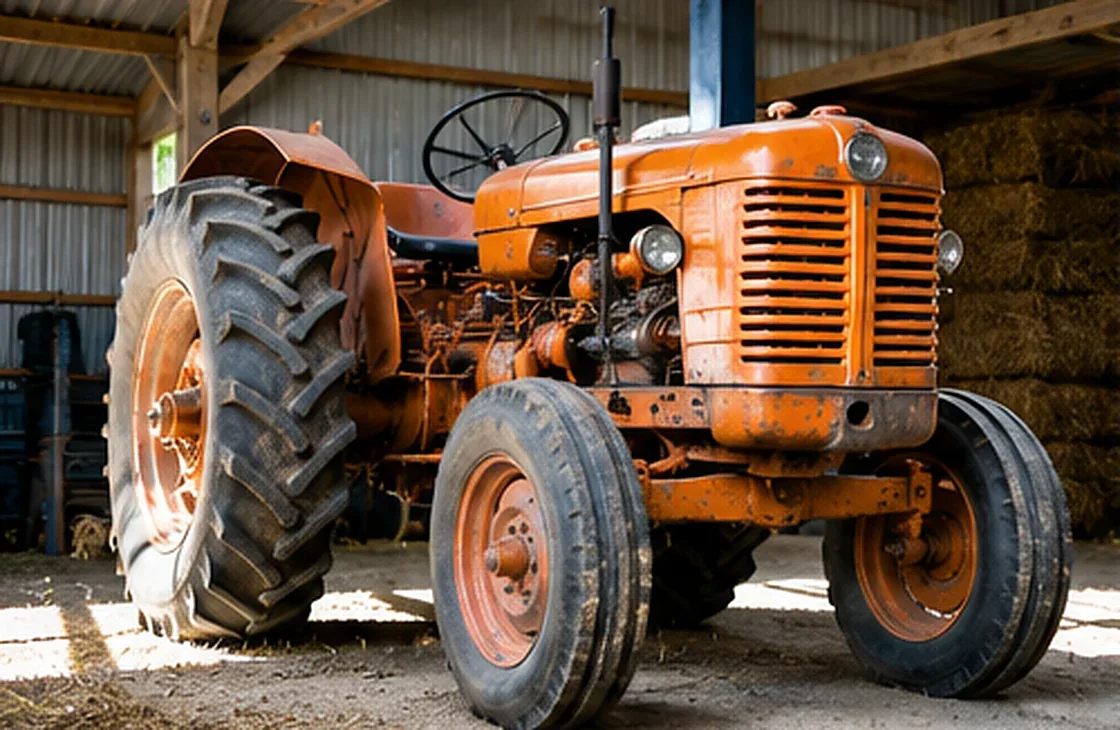
Does your old tractor crank slowly, click without turning the engine or not respond at all? On a machine that is 30, 40 or 50 years old, finding the right starter motor takes some method: fitments changed from one series to the next, and many tractors have already received a replacement starter.
The good news: most starters for vintage tractors are still available new or have a modern equivalent. Here is how to identify the right part, make by make.
Key points
- The number stamped on the removed starter is the best starting point, ahead of the tractor model.
- The engine type (Perkins, Deutz, MWM…) matters as much as the tractor model.
- Check voltage, power, number of teeth, mountings, spigot diameter and direction of rotation.
- A modern gear-reduction starter often replaces an old direct-drive starter, provided the fitment matches.
Can you still find new starters for old tractors?
Yes. Even when the original part (Paris-Rhône, Ducellier, Bosch, Lucas, Iskra, Magneti Marelli, Delco Remy…) has not been made for decades, a new equivalent usually exists. It is identified by the technical characteristics of the part rather than by its old brand.
How do you identify the right starter?
Before ordering, gather this information, ideally with the removed starter in front of you:
- The part number stamped on the starter or its plate.
- The make, model and year of the tractor, and above all the engine type.
- The voltage: 12 V in the vast majority of cases, 24 V on some large older tractors.
- The power in kW.
- The pinion: number of teeth and diameter.
- The mountings: number of holes, centre distance, spigot diameter.
- The direction of rotation and overall dimensions.
On an old machine, the starter fitted today is not necessarily the original one: after several repairs, adaptations are common. Always compare with the part you actually removed.
Direct-drive or gear-reduction starter?
Many old tractors left the factory with a direct-drive starter, heavy and power-hungry. Today’s gear-reduction starters are more compact, lighter and crank the engine better in cold weather with the same battery. They often replace the old model if the mountings, pinion and pinion position match. The details are explained in gear-reduction vs direct-drive tractor starters.
The most sought-after models by make
These are the series we are asked about most often. For each one, the number on the removed starter remains the starting point.
Renault Agriculture
Renault D22, D30, D35, N70, N71, N72, Super 3, Super 5, Super 6, Super 7, Super 6D, Super 7D, 56, 60, 70, 80, 86, 88, 89, 90, 95, 98, 551, 651, 751, 851, 951. Original fitments often come from Paris-Rhône, Ducellier or Bosch; an old number that can no longer be found usually has a modern equivalent.
Massey Ferguson
MF 35, 35X, 37, 65, 130, 133, 135, 140, 145, 148, 152, 155, 158, 165, 168, 175, 178, 185, 188. Depending on the year, these tractors received several starters, particularly on Perkins engines: the engine type is decisive.
Someca / Fiat
SOM 20, SOM 25, SOM 30, SOM 35, SOM 40, SOM 40H, SOM 45, SOM 50, SOM 55, SOM 511, SOM 612, SOM 615. There are many old Fiats too. After decades of repairs, the starter in place is often already a replacement unit.
International Harvester / McCormick
Farmall, IH 323, 353, 423, 433, 453, 523, 533, 553, 624, 633, 654, 724, 733, 744, 745, 824, 833, 844. Several generations coexist within the same series: the number on the part avoids mistakes.
Ford / Fordson
Fordson Major, Super Major, Dexta, Super Dexta. Original Lucas starters are common; the exact number helps avoid a fitment error.
Deutz, John Deere, Zetor
Zetor 2011, 3011, 4011, 4511, 4712, 4911, 5011, 5211, 5511, 5711, 6011, 6211, 6711, 6911, 7011, 7211. Air-cooled Deutz engines often use Bosch starters whose number leads easily to an equivalent. On older John Deere tractors, several starters may be listed for the same tractor: compare with the removed part.
Before replacing the starter: useful checks
On an old tractor, a tired battery, original cables that are too thin or a corroded earth will make any starter turn slowly. Check them first, especially in winter. See also tractor cranking slowly in winter, starter spinning freely. To decide between repair and replacement, see tractor starter repair.
What to check and why
| Criterion | Risk if wrong |
|---|---|
| Voltage 12 V / 24 V | Starter destroyed or lacking power |
| Number of pinion teeth | Pinion does not mesh, ring gear damaged |
| Mountings and spigot | Impossible or misaligned fitting |
| Direction of rotation | Starter unusable |
| Pinion position (engagement dimension) | Pinion rubs or does not reach the ring gear |
Frequently asked questions
My starter’s plate is no longer readable. What can I do?
Count the pinion teeth, measure the mounting centre distance and spigot diameter, note the engine type and take photos from several angles: our technicians can find the equivalent.
Is a more powerful starter a problem?
Generally not, with an identical fitment: it will crank the engine better. The number of teeth and the mountings, however, must be identical.
Can an old tractor be converted from 6 V to 12 V?
It is a complete conversion of the circuit (starter, alternator or dynamo, bulbs, gauges) and has to be planned case by case.
For the charging circuit on vintage tractors, see also vintage tractor alternator: D+, W terminals and regulator.
Find the right part
AutoTruck42, a French company based in the Loire, supplies new starters with a 2-year warranty for old and recent tractors:
Send us the number or photos of your old starter: we check compatibility before dispatch.
Further reading
Browse our catalogue of car and truck parts.