 Starter motor & alternator specialist
 Truck and van parts
 New parts with a 2-year warranty

 Contact an expert


Old tractor: identifying the B+, D+ and W terminals and the type of regulation before replacing the alternator, wiring the warning light correctly and avoiding mistakes on a dynamo conversion.
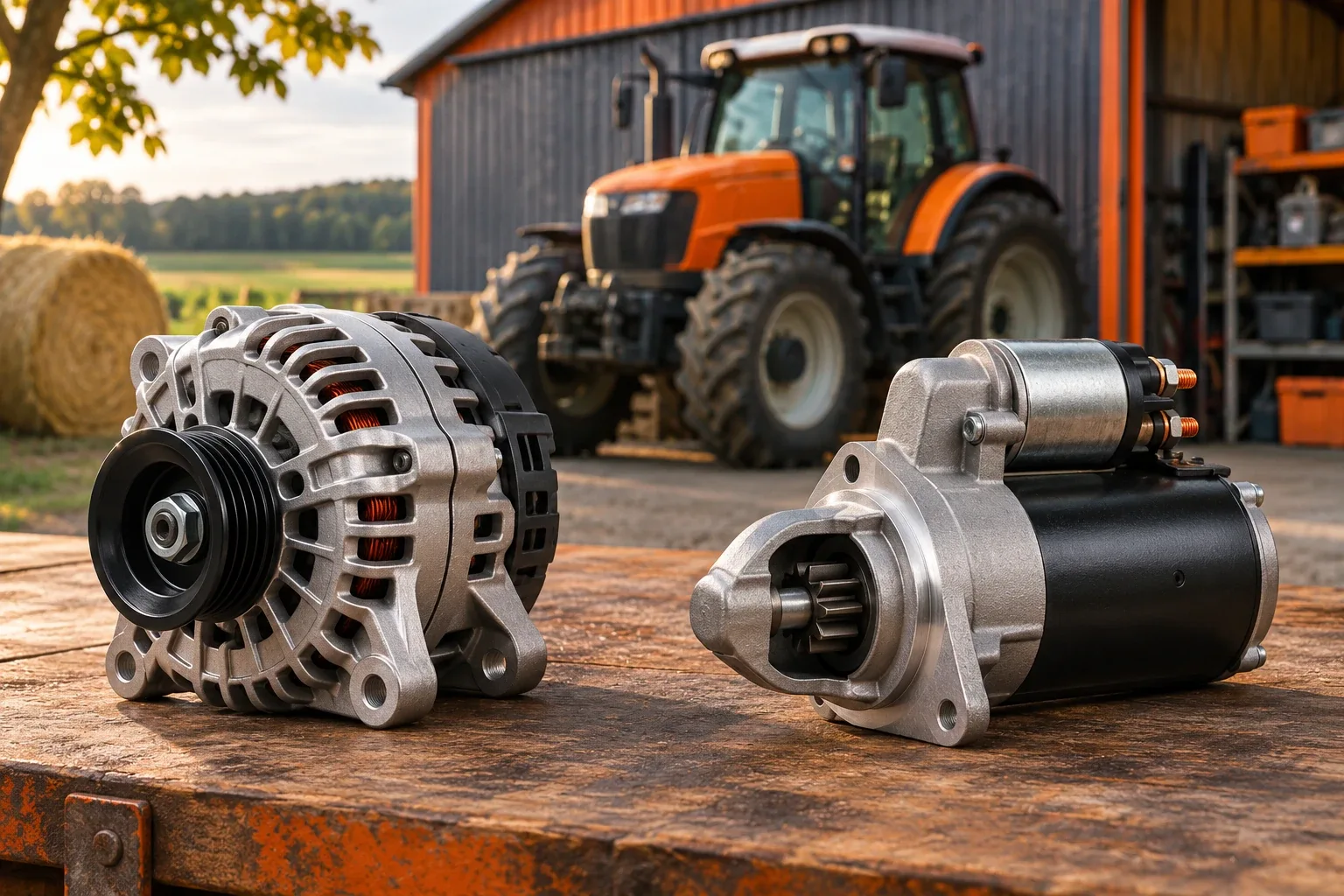
On an old tractor, replacing the alternator starts with identifying what is really fitted: an alternator with a built-in regulator, a separate regulator, or even a converted dynamo. The B+, D+ and W terminals have different roles, and a wiring mistake can prevent charging or destroy the regulator. Here is how to find your way.
Key points
- B+ is the power output to the battery; D+ supplies excitation and the warning light; W provides a signal for the rev counter.
- Without a warning light correctly connected to D+, many alternators do not self-excite and do not charge.
- A separate regulator (box on the wing or bulkhead) cannot be replaced by an alternator with a built-in regulator without revising the wiring.
- Note the wiring and photograph the terminals before removing anything.
What are the B+, D+ and W terminals for?
| Terminal | Role | What connects to it |
|---|---|---|
| B+ (or 30) | Charging current output | Power cable to the battery or starter |
| D+ (or 61) | Excitation at start-up and charge warning | Charge warning light wire (bulb or dashboard indicator) |
| W | AC signal proportional to engine speed | Rev counter or hour meter, if fitted |
| D– / 31 / earth | Earth return | Engine block or dedicated earth cable |
| DF | Field excitation (separate regulator) | External regulator only |
Built-in or separate regulator: how to tell?
An alternator with a built-in regulator usually has only B+, D+ and sometimes W, with the regulator fixed at the rear together with the brushes. A separate-regulator setup also has a DF terminal linked to a box mounted elsewhere on the tractor. The two systems are not interchangeable without modifying the harness. On a tractor converted from a dynamo, the original wiring may have been adapted: follow each wire, do not rely on colours.
The charge warning light, often forgotten
When the ignition is switched on, the current through the warning light reaches D+ and excites the alternator. If the bulb is blown, disconnected or replaced by an LED that draws too little, the alternator may never self-excite: the battery goes flat even though the alternator is new. Check that the light comes on with the ignition and goes out with the engine running. On a setup without a light, a suitable excitation resistor is sometimes fitted.
Steps before replacing the alternator
- Photograph the terminals and note each wire with its colour and destination.
- Note the part number of the alternator and of the regulator if separate.
- Check the voltage: about 12.6 V with the engine off, 13.5 to 14.8 V with the engine running on a 12 V tractor.
- Check the belt, pulley and direction of rotation (fan and arrow on the housing).
- Measure the voltage drops on B+ and earth before concluding.
The measurement method is detailed in testing a 12 V alternator with a multimeter. If the alternator overheats or gets dirty, see tractor alternator overheating. For the same tractor’s starter, see starter motor for an old tractor.
Frequently asked questions
Why is my new alternator not charging?
Most often the charge warning light is not connected or is blown: the alternator does not excite. Also check the direction of rotation and the D+ wiring.
Can the W terminal be left unused?
Yes if the tractor has no rev counter connected to it. Otherwise, the replacement alternator must have a compatible W output.
Can a dynamo be replaced with an alternator?
Yes, it is common, but wiring, regulation, pulley and mounting must be adapted. A wiring diagram is essential.
Find the right part
AutoTruck42, a French company based in the Loire, supplies new alternators with a 2-year warranty for old and recent tractors, as well as regulators and spare parts:
- Alternators for tractors and farm machinery
- Alternator voltage regulators
- Alternator spare parts
- All new alternators
Send us your alternator number and the tractor’s make and model: our technicians check compatibility before dispatch.
Further reading
Browse our catalogue of car and truck parts.