 Starter motor & alternator specialist
 Truck and van parts
 New parts with a 2-year warranty

 Contact an expert


Two alternators that look identical can have different regulation. Conventional or smart alternator, LIN, COM, BSS, PWM: how to identify the regulation before ordering.
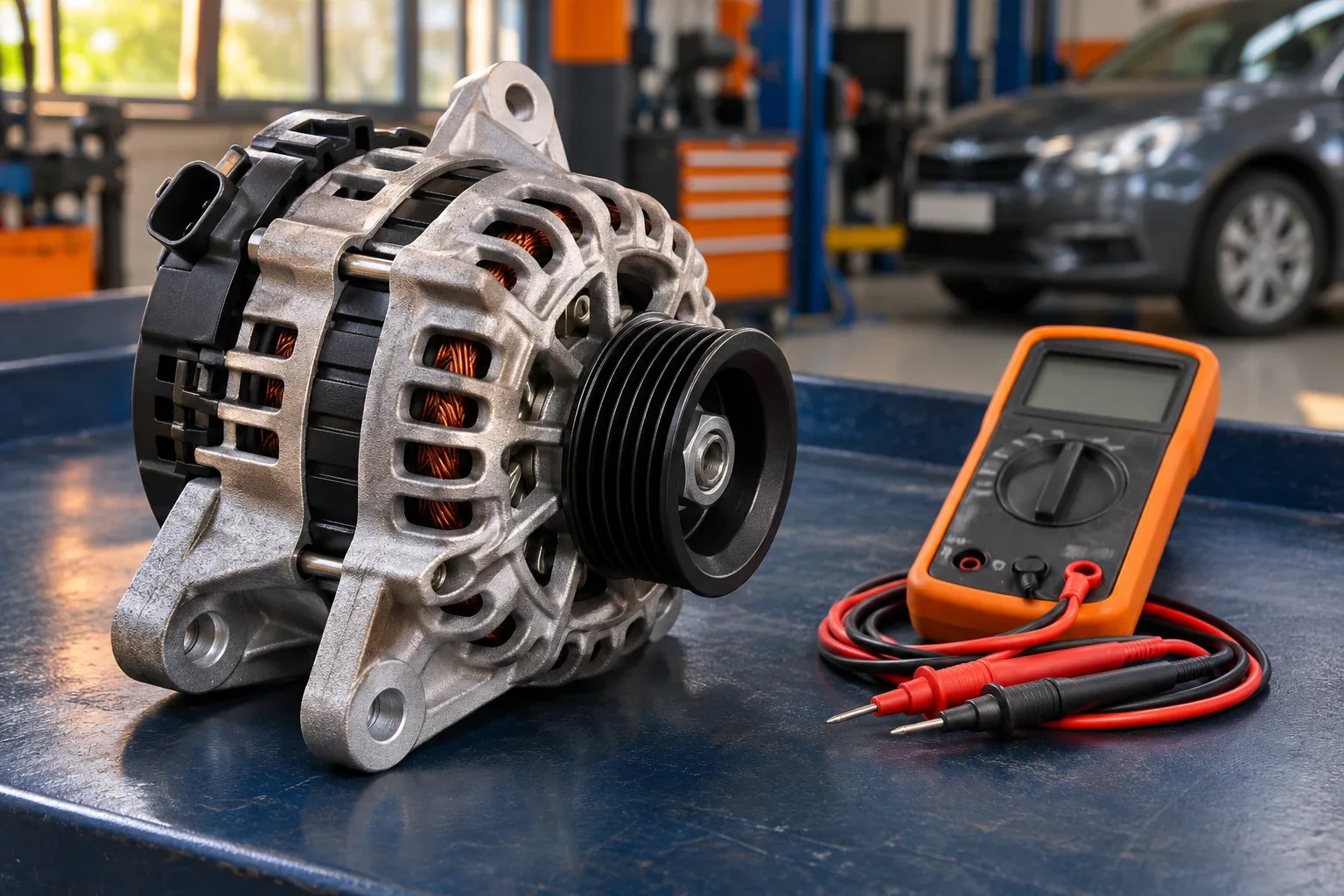
On many recent vehicles, the alternator no longer regulates itself: the engine ECU tells it what voltage to produce. Two alternators that look identical, same connector, same amperage, can then have different regulation and fail to work on the same vehicle. Here is how to identify the regulation before ordering.
Key points
- A smart alternator receives its set-point from the ECU over a communication link (LIN, BSS or PWM depending on the manufacturer).
- An identical connector does not guarantee compatibility: the protocol, address and regulator must match.
- The full number of the original alternator is the only reliable way to select one.
- An alternator of the wrong variant can be fitted, charge poorly and trigger a warning light or fault code.
Conventional or smart alternator: what is the difference?
A conventional alternator has a self-contained regulator that holds a fixed voltage, usually between 13.5 and 14.8 V on a 12 V circuit. A smart alternator varies its voltage on the ECU’s command: stronger charging on deceleration to recover energy, reduced charging under acceleration to relieve the engine, adjustment to battery condition. This is what makes Start & Stop and lower fuel consumption possible.
The main smart regulation types
| Name | Principle | Watch out for |
|---|---|---|
| LIN | Two-way digital communication bus between ECU and regulator | Several versions and addresses exist: an identical LIN connector is not enough |
| COM | Term used by some manufacturers for a communicating regulator | Not a single protocol: refer to the manufacturer’s data sheet |
| BSS | Synchronous digital signal used by some vehicle makers | Incompatible with a LIN regulator, even if the connector looks alike |
| PWM (RC or G control) | Pulse-width modulated signal that sets the target | Signal direction and range specific to the vehicle maker |
| Conventional (D+, L, IG, S) | Self-contained regulation, charge warning light | No communication with the ECU |
How do you identify your alternator’s regulation?
- Note the full number on the alternator label, including suffixes and indexes.
- Note the vehicle maker’s number if it appears on the label or in the vehicle documentation.
- Photograph the connector from the front, showing the number of pins and their markings.
- Note the amperage, the pulley diameter and type (fixed or overrunning).
- Give the chassis number (VIN): it identifies the factory-fitted variant.
What happens with the wrong variant?
The alternator fits and the belt turns, but the ECU cannot control it. Depending on the case: charge light on, communication fault code, voltage locked at a fallback value, Start & Stop disabled or a battery that slowly drains. A link fault code does not, however, prove the alternator has failed: the connector, wiring or ECU may also be at fault.
To read measurements correctly on a smart alternator, see testing a 12 V alternator with a multimeter. If the light comes on while driving, see battery light on while driving. Smart alternators are often fitted with an overrunning pulley: see overrunning alternator pulley.
Frequently asked questions
Can a smart alternator be replaced with a conventional one?
No, unless the vehicle maker explicitly allows it. The ECU expects to communicate with the regulator; without it, charging and related functions are disrupted.
Is a diagnostic tool needed after replacement?
On some vehicles, yes: fault codes must be cleared, and the battery or battery sensor may need initialising. Follow the vehicle maker’s procedure.
Can a LIN regulator be replaced on its own?
Yes, if the regulator number exactly matches the original. A LIN regulator of another version will not communicate correctly.
Find the right part
AutoTruck42, a French company based in the Loire, supplies new alternators with a 2-year warranty, with conventional and smart regulation, as well as matching regulators:
- Alternators for cars and vans
- Alternators for trucks and lorries
- Alternator spare parts, regulators included
- All new alternators
Send us the full number of your alternator and a photo of the connector: our technicians check the regulation before dispatch.
Further reading
- Faulty alternator: symptoms, charging voltage and choosing the right part
- Starter, alternator and driveline parts: comparing fitments
- Old tractor alternator: D+, W terminals and regulator to check
- JCB or Case backhoe loader alternator: terminals, voltage and part number
- Repair an alternator (regulator, diodes) or replace it: which to choose?
Browse our catalogue of car and truck parts.