 Starter motor & alternator specialist
 Truck and van parts
 New parts with a 2-year warranty

 Contact an expert


Diesel or LPG forklift with a draining battery: belt, connections, warning light, regulation and short-cycle use to check before replacing the alternator.
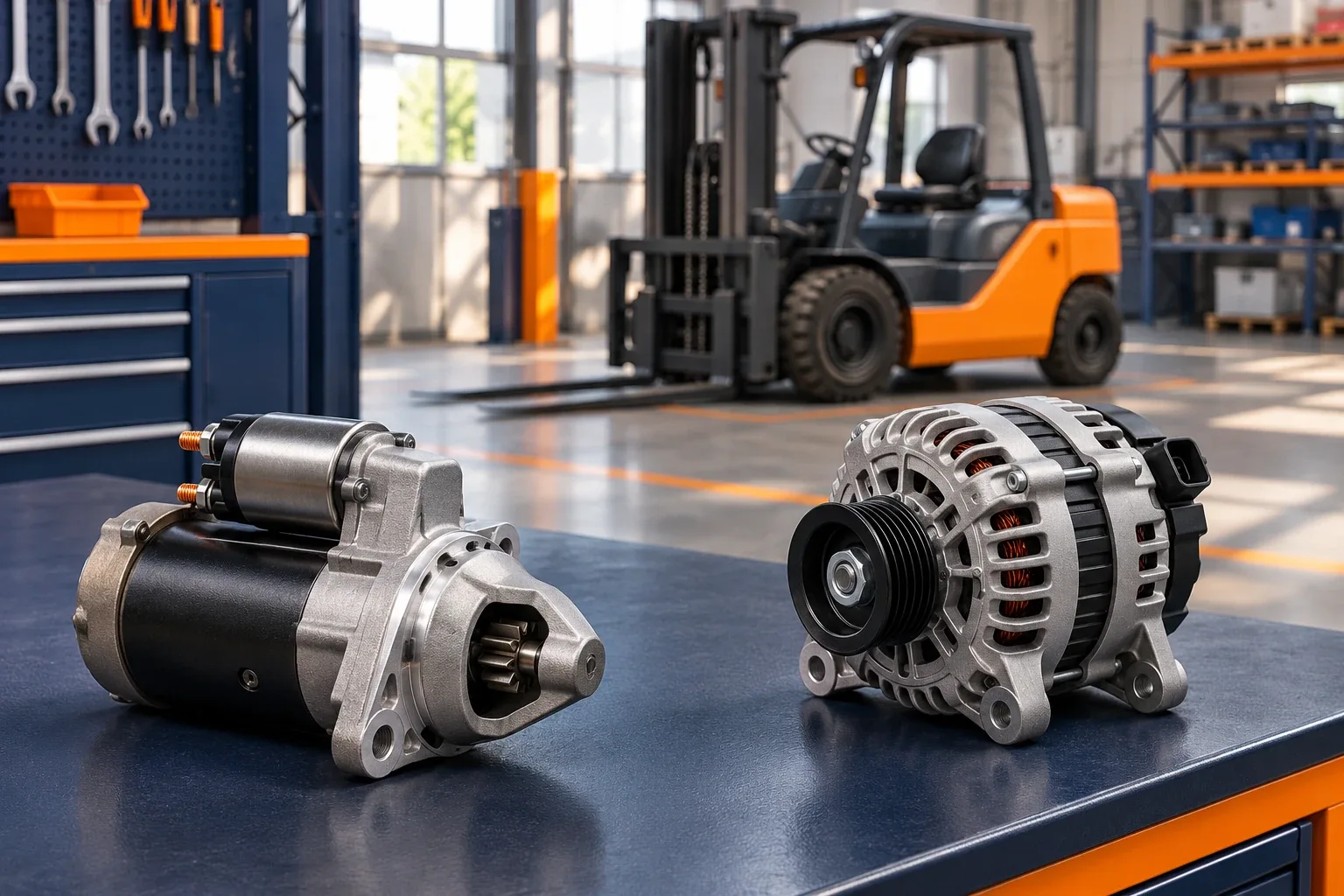
An internal combustion forklift (diesel, LPG or petrol) works in short manoeuvres, at idle, with many starts: a tough duty for charging. When the battery drains or the warning light comes on, the alternator is not always to blame. Here are the checks to make in order before ordering a part.
Key points
- With the engine running, voltage should reach about 13.5 to 14.8 V on a 12 V forklift, 27.5 to 28.5 V on 24 V.
- Terminals corroded by warehouse humidity and washing are a very common cause of poor charging.
- Many forklifts have a charge warning light that excites the alternator: a blown bulb prevents charging.
- Repeated starts and idling can drain the battery even with a healthy alternator.
Causes to check first
| Cause | Clue | Check |
|---|---|---|
| Slack or worn belt | Squeal, light on at idle | Belt tension and condition, pulley |
| Corroded terminals and earths | Irregular charging, hot terminals | Clean, tighten, voltage drops |
| Charge warning light out of order | Light off with ignition on | Bulb, connector, D+ wire |
| Worn battery | Weak start even after recharging | Charged battery test |
| Worn regulator or brushes | Low or unstable voltage | Measurement at several engine speeds |
| Faulty rectifier | Battery flat after standing | Parked current draw, ripple |
How do you measure charging on a forklift?
- Charged battery, engine off: about 12.6 V on 12 V, 25 V on 24 V.
- Engine at idle: voltage should rise into the charging range.
- Engine revved, lights and beacon on: voltage should stay stable.
- Measure between the alternator B+ terminal and battery positive, then between the housing and battery negative: above 0.5 V and 0.3 V, the connection is at fault.
- If all is correct, check the parked draw (accessories, beacon, on-board terminal).
The detailed method is in testing a 12 V alternator with a multimeter.
How the forklift is used matters as much as the alternator
A forklift that only makes short manoeuvres at idle, with a start every few minutes, can use more energy for starting than the alternator puts back. The beacon, work lights, cab heater or an on-board fleet terminal add a permanent draw. In that case the battery drains gradually without the alternator being faulty: the usage or equipment needs reviewing, not just the part.
Choosing the replacement alternator
Note the alternator’s full part number, the forklift’s make and model, and the engine type and serial number. Compare voltage, amperage, mounting, pulley and terminals. Cross-references between forklift brands are detailed in Toyota, Nissan, Fenwick forklift alternator. If starting is the problem, see IC forklift that will not start.
Frequently asked questions
Why does my forklift battery drain when the alternator is new?
Often because of corroded terminals, a faulty charge warning light or short-cycle use. Measure the charging and the voltage drops.
Can a forklift be washed with a pressure washer?
Avoid aiming at the alternator and connections: water causes corrosion and charging faults.
Which alternator for an LPG forklift?
The same principle as for a diesel: the original part number and the engine determine the unit. The fuel does not change the alternator.
Find the right part
AutoTruck42, a French company based in the Loire, supplies new alternators with a 2-year warranty for internal combustion forklifts, as well as spare parts:
Send us your alternator number and the forklift’s make and model: our technicians check compatibility before dispatch.
Further reading
Browse our catalogue of car and truck parts.