 Starter motor & alternator specialist
 Truck and van parts
 New parts with a 2-year warranty

 Contact an expert


Lithium leisure battery in a van or motorhome: why not to connect it directly to the alternator, the role of the DC-DC charger, sizing and precautions with a smart alternator.
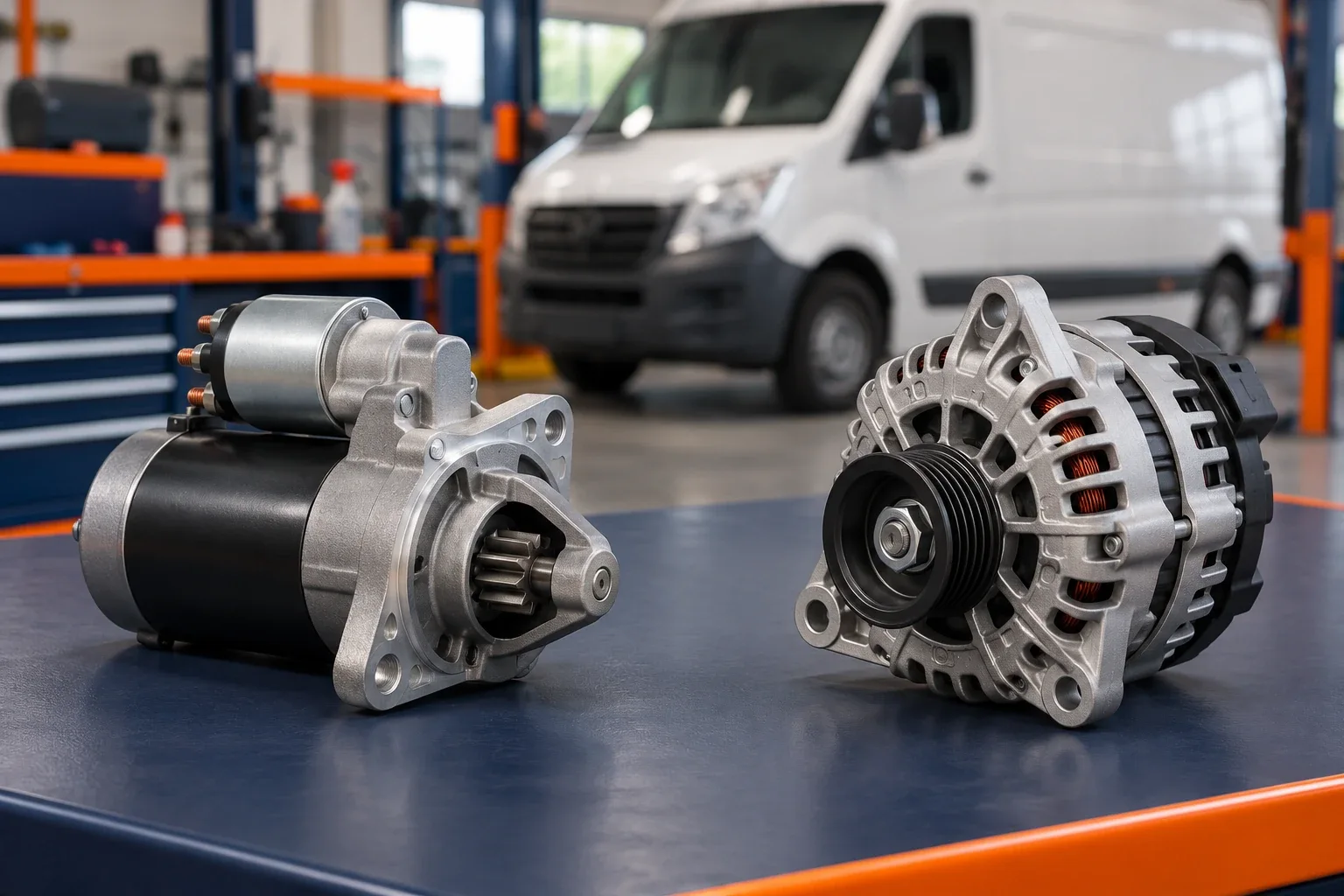
A lithium leisure battery accepts a very high charging current for a long time. Connected directly to a van’s alternator, it can keep it working at full load for hours, to the point of overheating and failure. Here is why a DC-DC charger is the usual solution, and how to install it without putting the alternator at risk.
Key points
- A lithium battery can absorb almost all the alternator’s current throughout the charge: that current must be limited.
- The DC-DC charger sets the current sent to the leisure battery and applies the right charging profile for lithium.
- On a smart alternator (Euro 6, Start & Stop), voltage can drop while driving: the DC-DC compensates, a simple split-charge relay does not.
- Plan for the BMS cut-off: a sudden disconnection of the battery during charging can cause an overvoltage.
Why not connect the lithium battery directly to the alternator?
A lead-acid battery limits the current by itself as it fills up. A lithium battery accepts a high current almost to the end of the charge. The alternator then runs close to its maximum for a long time, often at idle or low revs with little cooling: it heats up, and the regulator and rectifier suffer. The cable and its protection can also be exceeded.
Split-charge relay, DC-DC or a more powerful alternator?
| Solution | Advantage | Limit |
|---|---|---|
| Split-charge relay | Simple, inexpensive | No current limiting; poorly suited to lithium and smart alternators |
| DC-DC charger | Limited current, suitable charging profile, compensates for low voltage | Charging current is capped by the charger rating |
| More powerful alternator | More output available | Solves neither charging profile nor current limiting: combine with a DC-DC |
How do you size the DC-DC charger?
- Start from the alternator’s actual output at the usual engine speed, not its maximum rating.
- Subtract the vehicle’s own consumption with the engine running (engine management, lighting, ventilation, air conditioning).
- Choose a DC-DC whose current stays well below the available margin.
- Size cables and fuses for the current and length, on both the input and output sides.
- Connect the start signal (D+ or voltage sensing) according to the type of alternator.
Precautions with a smart alternator
On many recent vans the alternator is controlled by the ECU: the voltage varies, sometimes drops below 13 V while driving and rises on deceleration. A DC-DC compatible with smart alternators keeps charging the leisure battery despite these variations. Do not modify the original regulation to force the voltage. To identify the regulation, see LIN or COM alternator; to choose the amperage, van alternator: 120 A, 150 A or more.
If the starter battery also drains when parked, see battery draining overnight. On a boat the same principle applies: see boat alternator and domestic battery.
Frequently asked questions
Is a more powerful alternator needed with a lithium battery?
Not necessarily. The DC-DC limits the current drawn; an original alternator in good condition is often enough. A more powerful unit is only justified if the electrical balance requires it.
Can the lithium battery be charged by solar only?
Yes, if production covers consumption. The DC-DC usefully tops up while driving, especially in winter.
Does the DC-DC protect the starter battery?
Yes: it only draws when the engine is running and isolates the leisure battery from the starter battery when parked.
Find the right part
AutoTruck42, a French company based in the Loire, supplies new alternators with a 2-year warranty for vans and campers, as well as regulators and rectifiers:
Send us your alternator number or chassis number: our technicians check compatibility before dispatch.
Browse our catalogue of car and truck parts.