 Starter motor & alternator specialist
 Truck and van parts
 New parts with a 2-year warranty

 Contact an expert


Master, Ducato, Transit, Sprinter: how to choose the amperage of a van alternator, when a more powerful unit is justified and what to check before fitting 150 A or 180 A.
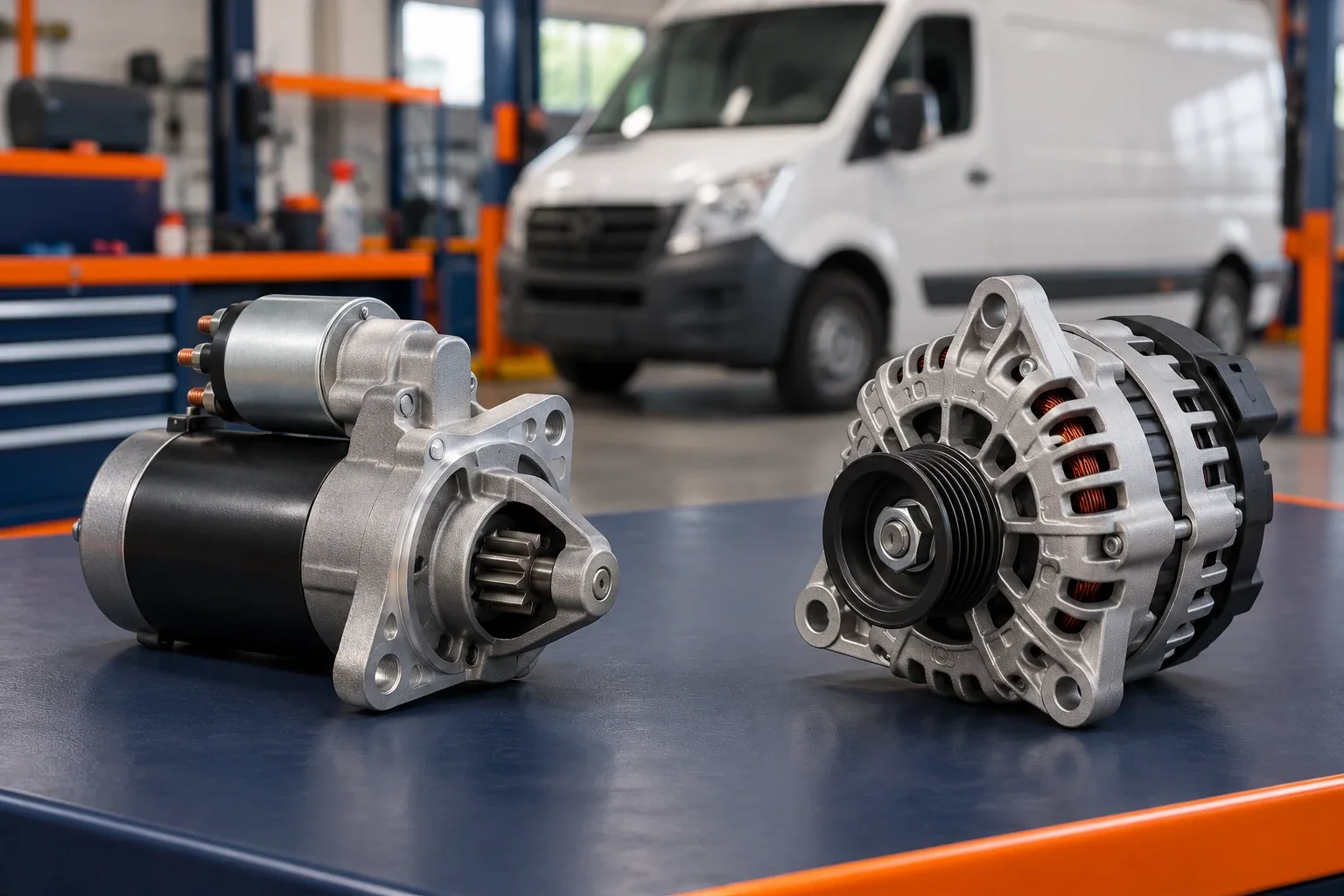
On a van, the same engine is often available with several alternators: 120 A, 150 A, 180 A, sometimes more. Fitting a more powerful unit does not make it more compatible and does not always fix a charging problem. Here is how to choose the right amperage for a Master, Ducato, Transit or Sprinter.
Key points
- The right starting point is the number of the fitted alternator or, failing that, the chassis number.
- The original amperage depends on options: air conditioning, auxiliary heater, Start & Stop, PTO, conversion.
- A more powerful unit is only useful if the electrical balance requires it, and only if pulley, mountings, connector and regulation are identical.
- A more powerful alternator needs a B+ cable and protection sized accordingly.
Why several amperages for the same vehicle?
Manufacturers size the alternator according to the equipment ordered. A basic panel van, a refrigerated vehicle, an ambulance or a motorhome do not have the same needs. A 120 A and a 180 A alternator can look alike from the outside while having a different pulley, regulation or connector: the original part number remains the only reliable criterion.
How do you assess the real need?
| Load | Order of magnitude | Note |
|---|---|---|
| Engine management, lighting, ventilation | Permanent base | Always present with the engine running |
| Air conditioning, demister, heated seats | High at times | Adds to the base |
| Electric refrigeration unit, inverter | High and sustained | Check the equipment manual |
| Charging a leisure battery | Variable | Limit the current, especially with lithium |
| Prolonged idling | Reduced output | The alternator produces less at low revs |
Add up the currents of equipment running at the same time and compare them with the alternator’s output at the usual engine speed, not just its maximum rating.
What to check before fitting a more powerful unit
- The pulley: same diameter, same number of grooves, overrunning if the original has one.
- Mountings and centre distances: a more powerful alternator is sometimes longer.
- Connector and regulation: conventional or smart (LIN, BSS…), they must be identical.
- The B+ cable, terminal and fuse: they must handle the new current.
- Belt and tensioner: higher loads speed up wear on a tired belt.
Conversions and leisure batteries
A conversion does not on its own justify a bigger alternator. Most often, a properly sized DC-DC charger handles leisure battery charging while protecting the alternator. Details are in camper van and lithium battery. To identify smart regulation, see LIN or COM alternator; to check charging, testing a 12 V alternator with a multimeter.
Frequently asked questions
Can a 120 A unit be replaced with a 150 A one?
Yes, if the vehicle maker offers that variant for the vehicle and if pulley, mountings, connector and regulation are identical. The wiring must match.
Does a more powerful alternator wear the engine more?
It only produces what the loads demand. Belt load only increases when demand is high.
Where do I find my alternator’s amperage?
On the alternator label, with its full part number. Failing that, the chassis number identifies the factory-fitted variant.
Find the right part
AutoTruck42, a French company based in the Loire, supplies new van alternators with a 2-year warranty in all original ratings:
Send us your alternator number or chassis number: our technicians check compatibility before dispatch.
Further reading
Browse our catalogue of car and truck parts.