 Starter motor & alternator specialist
 Truck and van parts
 New parts with a 2-year warranty

 Contact an expert


Emissions light, loss of power or repeated regenerations: how to recognise a blocked DPF, find the cause (injector, EGR, oil, sensor) and choose between regeneration, cleaning and replacement.
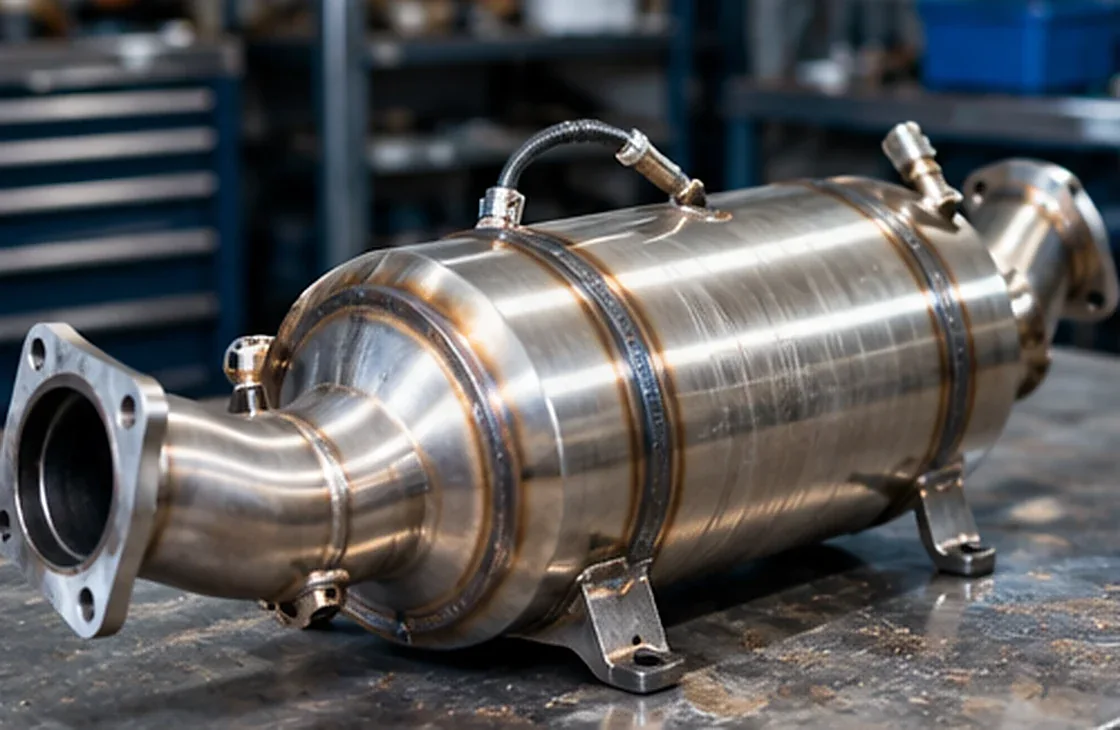
Emissions warning light, loss of power, limp mode or repeated regenerations: a blocked diesel particulate filter (DPF) can immobilise a diesel car or a truck. But a full DPF is often the consequence of another fault. Here is how to recognise the symptoms, find the cause and choose between regeneration, cleaning and replacement.
Key points
- A DPF normally fills with soot and burns it off during regenerations; it blocks when those regenerations stop completing.
- Short trips and faulty injectors, EGR valve, turbo or differential pressure sensor are the most common causes.
- Oil ash does not burn: beyond a certain mileage, only cleaning or replacement removes it.
- Replacing a DPF without dealing with the cause risks blocking it again.
What does a diesel particulate filter do?
Fitted in the exhaust line, the DPF traps the soot particles produced by burning diesel. When it is loaded, the engine ECU starts a regeneration: exhaust gas temperature rises to burn off the soot. On trucks, passive regeneration also takes place while driving thanks to the diesel oxidation catalyst upstream. Ash from the oil additives, however, does not burn and builds up over the miles.
Which symptoms point to a blocked DPF?
Emissions warning light or message
“DPF blockage risk”, “Check emissions system”, engine warning light: the message alone does not mean the filter must be replaced. The fault codes need to be read.
Loss of power and limp mode
Exhaust back-pressure rises and the ECU limits power to protect the engine.
Very frequent regenerations
The vehicle tries to regenerate far more often than before, or asks for a parked regeneration more and more often.
Higher fuel consumption
Each regeneration uses fuel; repeated cycles show up in fuel consumption.
Unusual smell or smoke
Black smoke signals excess soot upstream; blue smoke, oil consumption that loads the filter with ash.
Why does a particulate filter block?
A DPF almost never blocks on its own. The most common causes:
- Usage: short trips, long idling, urban delivery work, which prevent the regeneration temperature from being reached.
- Combustion: a leaking or poorly atomising injector, a clogged EGR valve, an intake air leak, a tired turbo: the engine produces too much soot.
- Oil: oil consumption (turbo, piston rings) or non-compliant oil, which loads the filter with ash.
- Sensors: a faulty differential pressure sensor or temperature sensor that distorts the soot load estimate and prevents regenerations.
- Repeatedly interrupted regenerations, for example by switching off the engine during the cycle.
These leads are covered in detail in truck EGR valves and black smoke on a truck.
In which order should you diagnose?
- Read the fault codes and ECU values: estimated soot load, differential pressure, temperatures, regeneration history.
- Check the sensors: differential pressure sensor, its pipes and the temperature sensors. A split pipe is enough to distort the reading.
- Find the source of the soot: injectors, EGR, intake, turbo, oil consumption.
- Try a forced regeneration with a diagnostic tool if the load level allows it and the cause has been dealt with.
- Decide: cleaning if the filter is sound but loaded with ash, replacement if the ceramic is cracked, melted or overloaded.
Symptom, likely cause and check
| Symptom | Likely cause | First check |
|---|---|---|
| Very frequent regenerations | Excess soot, short trips | Injectors, EGR, vehicle usage |
| DPF light despite a recent filter | Pressure sensor or pipe | Differential pressure values |
| Loss of power, limp mode | High back-pressure | Soot load, filter condition |
| Blue smoke, falling oil level | Oil consumption | Turbo, breather, engine |
| Regeneration impossible | Load too high or ash | Cleaning or replacement |
Regeneration, cleaning or replacement?
Regeneration
It burns off soot, not ash. It can be triggered while driving (sustained speed on a fast road) or forced with a diagnostic tool. It is pointless if the cause of the blockage is still there.
Cleaning
It removes soot and ash off the vehicle, by a thermal or hydraulic process. It suits a filter whose ceramic is intact. Additives sold in bottles do not remove ash.
Replacement
It is necessary if the ceramic is cracked or melted, if the filter has reached its ash limit, or if cleaning does not restore correct back-pressure. After fitting, the ECU learning procedure (resetting the DPF values) must be carried out.
Heavy trucks
On a truck, the DPF is part of an assembly with the oxidation catalyst and the AdBlue SCR system. Passive regeneration while driving is often enough on long-haul work, but distribution, tippers and machines that idle a lot need active or parked regenerations. Ash cleaning is part of maintenance at intervals set by the manufacturer. To go further: truck particulate filters: soot, ash and regeneration.
How do you choose a replacement DPF?
Always start from the number stamped on the original filter or the vehicle manufacturer’s number, then check:
- compatibility with the engine and the vehicle’s Euro standard;
- dimensions, flanges and mounting points;
- sensor positions (pressure, temperature);
- whether the catalyst is built into the same unit.
Frequently asked questions
Can you drive with a blocked DPF?
For a short distance, in limp mode, to reach a workshop. Carrying on risks overheating the exhaust, damaging the turbo and a destructive regeneration of the filter.
Can an additive unblock a DPF?
An additive can help soot burn off, but it does not remove ash and does not fix a mechanical cause.
Can the DPF be removed?
No: it is illegal on a vehicle used on public roads and causes a roadworthiness test failure.
Find the right part
AutoTruck42, a French company based in the Loire, supplies new particulate filters for trucks and emissions control parts:
- AdBlue, catalysts and particulate filters
- Particulate filter Renault Trucks 7421716414
- Particulate filter Mercedes-Benz 0014903292
- Particulate filter Scania 2097594
- Particulate filter Iveco Stralis / Trakker 5801651187
- Particulate filter MAN TG 81.15103.0107
Send us the number of your original filter or the vehicle VIN: our technicians check compatibility before dispatch.
Further reading
Browse our catalogue of car and truck parts.