 Starter motor & alternator specialist
 Truck and van parts
 New parts with a 2-year warranty

 Contact an expert


Volvo FH, Renault Magnum, Actros, DAF XF: on a 44-tonne truck, the 24 V starter depends on the engine. Power, teeth, spigot and part numbers to find the right one.
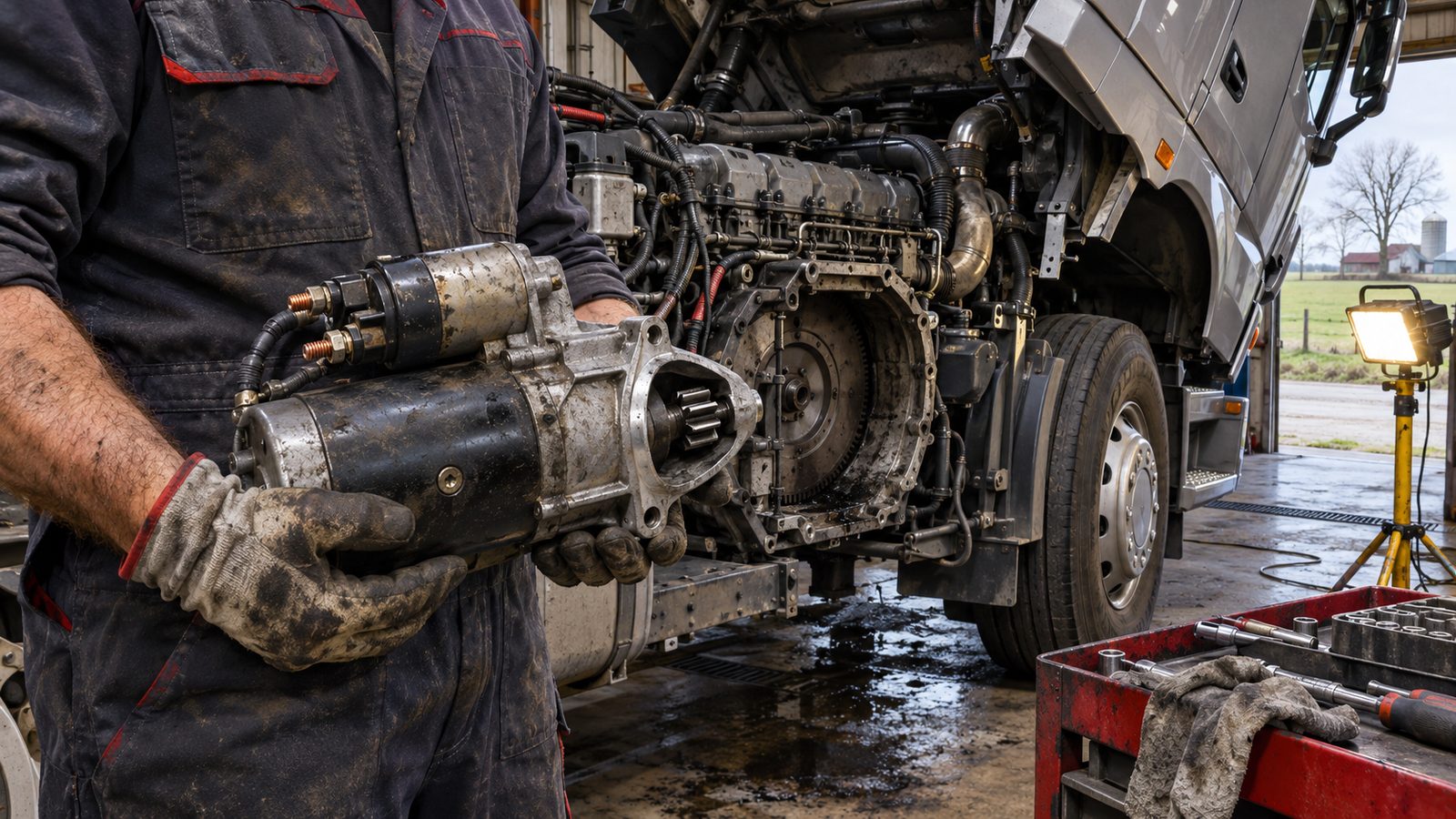
Under the tilted cab of a tractor unit, the starter motor does not look like much: a dozen kilos of steel, the size of a forearm. Yet it has to crank a 10- to 13-litre six-cylinder engine every morning, summer and winter. And contrary to a common belief, there is no such thing as "the" 44-tonne starter: from one make to another, and sometimes from one engine to another at the same manufacturer, power, number of teeth and flange all change. Here is how to find your way before ordering.
Key points
- All tractor unit starters run on 24 V, fed by two 12 V batteries in series.
- Their power is usually between 5.5 and 7 kW, with a 9- to 12-tooth pinion depending on the engine.
- A single truck make can use several starters: the engine, not the cab model, decides.
- The number stamped on the old starter (Bosch, Mitsubishi, Prestolite, Delco Remy or the truck maker's number) remains the safest key.
Why is a heavy truck starter nothing like a car's?
A car starter delivers about 1 to 2 kW at 12 V. A tractor unit's has to overcome the compression of an engine of more than ten litres, often in the cold, with thickened oil. Hence the doubled voltage, 24 V, which carries several kilowatts without oversized cables, and a reinforced design: heavy housing, wide pinion, often an internal reduction gear. The role of the 24 V circuit and the two batteries is explained in our main article 44-tonne truck: rules, dimensions and 24 V electrics.
Which starter for which tractor unit?
A few examples from our catalogue show how much fitments vary:
| Trucks and engines | Starter | Main references |
|---|---|---|
| Volvo FH (D13, from 2005), Volvo FMX; Iveco Stralis, Trakker, Eurotech, Eurostar | 24 V, 5.5 kW, 12 teeth, 92 mm spigot | Volvo 20851685, 85000806; Mitsubishi M9T68871, M009T66471 |
| Renault Trucks Magnum (DXi12, DXi13) and Kerax (DXi13); Volvo FH (D13A380/400); MAN TGX 24.440 (D2676); Iveco Stralis | 24 V, 5.5 kW, 12 teeth, 92 mm spigot | Volvo 20430565, 20891242; Bosch F042001199, 0001261049; Mitsubishi M009T62173AM |
| Mercedes-Benz Actros (OM470, from 2011), Arocs, Antos | 24 V, 7 kW, 11 teeth, 92 mm spigot | Mercedes-Benz A0071517501, A0071514401; Mitsubishi M009T87474AM, M9T87472AM |
| DAF XF 105 and 95, DAF CF 85 (MX and XE engines); MAN TGA (D2876) | 24 V, 5.5 kW, 12 teeth, 110 mm spigot | Bosch 0001261086; DAF 2165365, 1739935; Prestolite M90R3544 |
Two lessons. First, different manufacturers sometimes share the same starter: Volvo, Renault Trucks, Iveco and MAN turn up on common Mitsubishi part numbers. Second, a detail such as the spigot diameter, 92 or 110 mm, is enough to make two starters of the same power incompatible.
How do you identify the right starter?
- Note the part number on the plate or housing of the old starter: Bosch (0001…), Mitsubishi (M009T…, M9T…), Prestolite (M90R…), Delco Remy, or the truck maker's number.
- Note the engine: it appears on the registration document or the vehicle plate (D13, DXi13, OM470, MX-13…). It determines the starter more than the cab model does.
- Failing that, measure: number of pinion teeth, number of mounting holes, spigot diameter, overall length and direction of rotation.
- Compare the power: a more powerful starter is not necessarily compatible, but one less powerful than the original struggles on a big cold engine.
The full method, with cross-references between makes, is in 24 V heavy truck starter: power, number of teeth and cross-references.
Tired starter or flat batteries?
On a 44-tonne truck, many starters are replaced for nothing. Before removing it, three checks:
- Each battery separately: one weak battery out of two is enough to make voltage drop when cranking.
- Cables and earth: on a chassis exposed to salt and spray, a corroded terminal causes a voltage drop invisible to the eye.
- The start relay and control circuit: a starter that does not receive a clean current clicks without turning.
Typical symptoms are covered in 24 V truck starter that clicks: the role of the two batteries. If the starter turns slowly although the batteries are healthy, or if it overheats and smells burnt, it needs replacing.
Frequently asked questions
How powerful is a 44-tonne truck starter?
Usually between 5.5 and 7 kW at 24 V. For example, 5.5 kW on many Volvo FH, Renault Trucks and DAF XF, and 7 kW on Mercedes-Benz Actros with the OM470 engine.
Can a Volvo FH starter fit a Renault Magnum?
In some cases, yes: common Mitsubishi starters cover Volvo FH with D13 engines and Renault Trucks Magnum with DXi engines. Compatibility is checked by part number, not by truck make.
Should the batteries be replaced at the same time as the starter?
Not systematically, but they must be checked. Weak batteries make the new starter work in poor conditions and shorten its life.
How many teeth should the pinion have?
It depends on the engine: 11 or 12 teeth on most recent tractor units, sometimes 9 on some MAN or Scania engines. The tooth count of the old pinion is what counts.
Finding the right part
AutoTruck42, a French company based in the Loire, supplies 24 V starters for most tractor units and trucks, new with a 2-year warranty, including:
- the Volvo 20851685 / Mitsubishi M9T68871 starter for Volvo FH and Iveco Stralis;
- the Mitsubishi M009T62173AM / Volvo 20430565 starter for Renault Trucks Magnum and Kerax;
- the Mercedes-Benz A0071517501 starter for Actros, Arocs and Antos;
- the Bosch 0001261086 / DAF 2165365 starter for DAF XF and CF;
- and all the others in the 24 V heavy truck starter motors category.
Send us the number of your starter or the engine type: we check compatibility before dispatch.
Browse our catalogue of car and truck parts.