 Starter motor & alternator specialist
 Truck and van parts
 New parts with a 2-year warranty

 Contact an expert


A tractor cranking sluggishly in cold weather: battery, cables, earth, safety switches, starter or pre-heating. Checks on the starting circuit, from the simplest to the most technical.
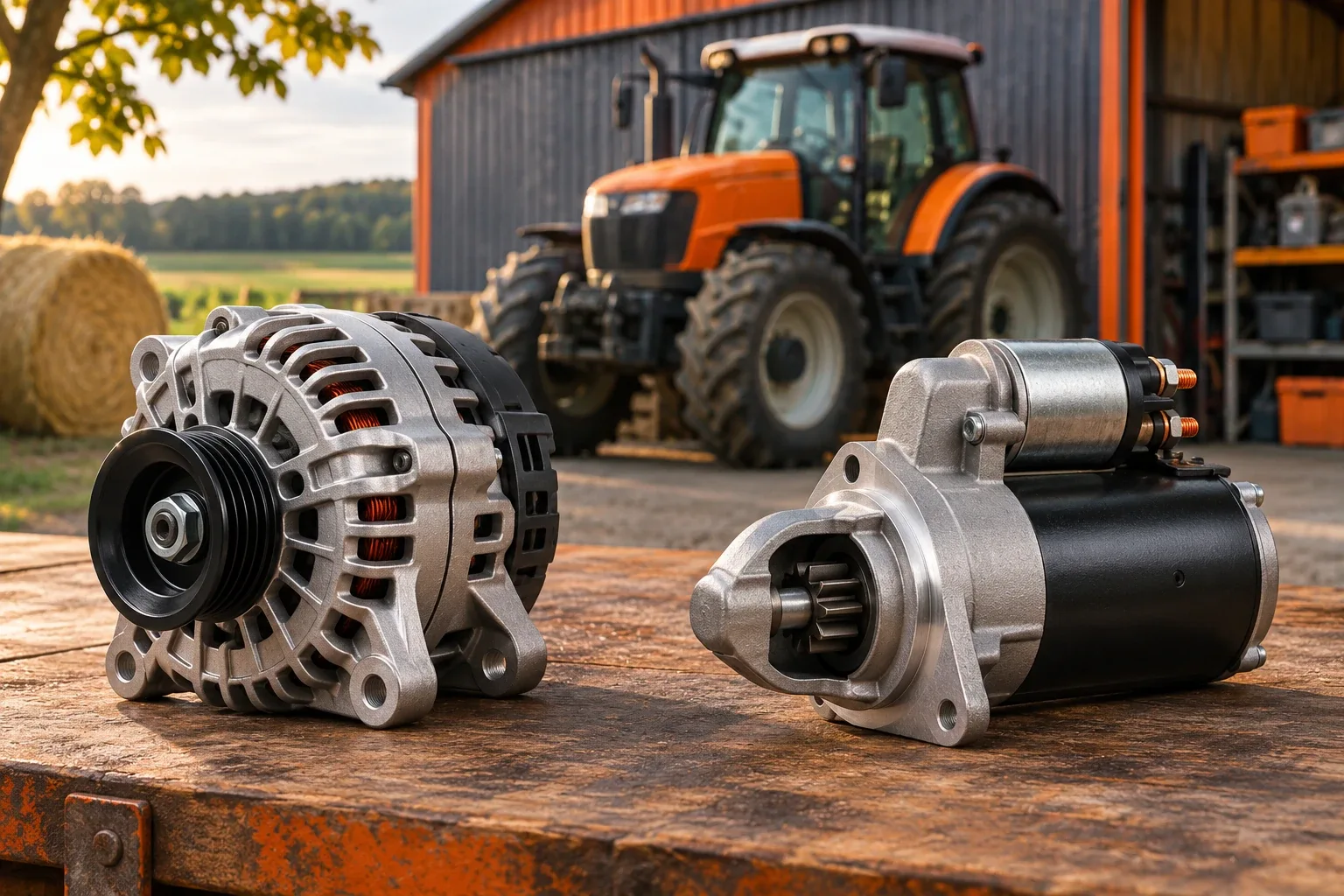
In winter, many tractors stand for days in a cold shed. When starting, the engine cranks slowly, hesitates, then finally fires… or not. Before replacing the starter, check the whole starting circuit: battery, cables, earths, safety switches and pre-heating. Here is the method.
Key points
- Slow cranking comes from a lack of current: battery, cables, earth or starter.
- Corroded earth straps and terminals are very common on tractors.
- Safety switches (clutch, neutral, PTO) cut the command and can cause intermittent starting.
- A reduction-gear starter cranks a large cold diesel faster than an old direct-drive starter.
A tractor’s starting circuit
Current leaves the battery, passes through the positive cable and sometimes an isolator, reaches the starter’s main terminal, flows through the electric motor and returns via the engine earth and negative cable. The command passes through the ignition key, safety switches and sometimes a relay. On a tractor these parts are exposed to moisture, mud and vibration. Every corroded connection adds resistance that slows the starter.
Checks in order
- Measure the battery at rest: 12.6 V when charged. Recharge it if the tractor has stood for a long time.
- While cranking, voltage should not drop below 9.6 V on 12 V.
- Clean and tighten battery and starter terminals.
- Check the engine-to-chassis earth strap and the negative cable.
- Measure voltage at the starter terminal while cranking: a difference of more than 0.5 V from the battery points to the cables.
- Check the safety switches: clutch down, neutral, PTO disengaged.
Pre-heating and fuel
If the engine cranks at normal speed but is slow to fire, the starter is not to blame. On tractors, pre-heating uses glow plugs, an intake manifold heater or a thermostart. A failed element gives hard starting with white smoke. Diesel can also wax in severe cold: use winter-grade fuel and replace the filter regularly.
When to replace the starter
- Voltage reaches the starter correctly but it cranks slowly.
- The starter gets abnormally hot or smells of burning.
- The starter clicks without turning although battery and cables are good.
- The pinion engages poorly or grinds on the ring gear.
Choosing and going further
The choice between direct-drive and reduction-gear starters is explained in reduction-gear or direct-drive tractor starter. For older Renault, Massey Ferguson, Someca or IH tractors: older tractor starter. Tractor starter faults and repair: tractor starter repair. For charging: older tractor alternator.
Frequently asked questions
Why does my tractor only start badly in winter?
Cold reduces battery capacity and thickens the oil: wiring faults or a worn starter that go unnoticed in summer then show up.
Is a more powerful starter needed for winter?
A reduction-gear starter of suitable power helps a lot, but only if the battery and cables are in good condition.
The tractor only starts when I move the gear lever, why?
The neutral safety switch is badly adjusted or worn: it cuts the starter command.
Find the right part
AutoTruck42, a French company based in the Loire, supplies new starter motors and alternators with a 2-year warranty for older and modern tractors:
Send us the tractor make, model and serial number or the starter part number: we check compatibility before dispatch.
Further reading
Browse our catalogue of car and truck parts.