 Starter motor & alternator specialist
 Truck and van parts
 New parts with a 2-year warranty

 Contact an expert


A click when starting but the engine does not turn: battery, terminals, earth, solenoid or starter? The checks to make in order to find the cause before replacing the starter.
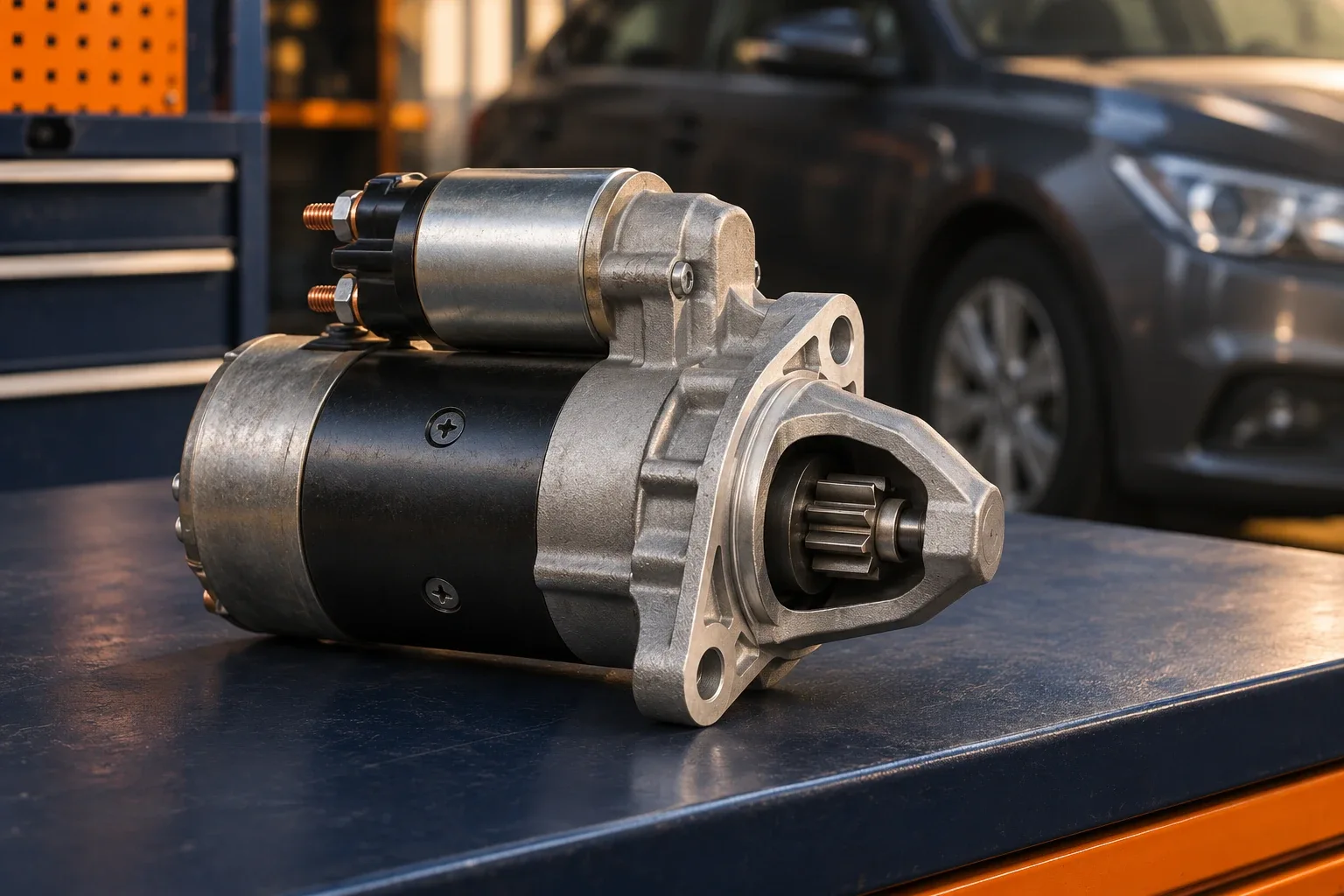
You turn the key or press the button: a sharp click, but the engine does not turn. This symptom is very common and does not always mean the starter is dead. The solenoid engages, but the main current does not reach the electric motor. Here is how to find the cause, step by step, before ordering a part.
Key points
- A single click with no rotation means the solenoid gets the command, but the main current is not getting through.
- The most common causes: weak battery, corroded terminal, faulty engine earth, worn solenoid contacts or starter brushes.
- Rapid repeated clicks (machine-gun) almost always mean a battery that is too weak.
- Measure voltage at the battery then at the starter during the attempt: a big difference points to the wiring.
One click or several?
| Symptom | Likely cause |
|---|---|
| One sharp click, nothing turns | Solenoid contacts, brushes, cable or earth |
| Rapid series of clicks | Battery too weak or loose terminal |
| Click then slow cranking | Weak battery or starter dragging |
| No sound at all | Control side: ignition switch, relay, safety switch, control wire |
Checks in order
- Measure battery voltage at rest: at least 12.4 V.
- During the start attempt, voltage should not drop below 9.6 V.
- Check battery terminals are tight and in good condition.
- Check the engine-to-body earth strap.
- Measure voltage on the starter’s main terminal during the attempt: if it is much lower than at the battery, a cable or connection is at fault.
- If voltage reaches the starter and nothing turns, the solenoid or brushes are worn.
Solenoid and brushes
The solenoid has two jobs: it pushes the pinion towards the ring gear and closes the main contact. Over time its copper contacts pit and no longer pass current. The electric motor’s brushes also wear. These parts can sometimes be replaced separately, but dismantling takes time: compare the options in solenoid, brushes or complete starter.
Special cases: stop-start, 24 V, tractors
On a vehicle with stop-start, the starter is reinforced and the battery is EFB or AGM: a standard battery fitted instead causes hesitant starts. See stop-start starter. On a 24 V truck, a click with no rotation often comes from one of the two batteries: see 24 V truck starter clicking. On a tractor, the safety switches (clutch, neutral, PTO) also cut the command: see tractor starting circuit.
What if the starter spins but does not crank the engine?
That is a different symptom: the motor spins freely, often due to the pinion drive or ring gear. See starter spinning freely. If the fault only appears when hot, read starter failing when hot. The general signs of a tired starter are summarised in symptoms of a failing starter.
Frequently asked questions
The starter clicks but will not turn, is it the battery?
Often, especially if the clicks repeat. Measure voltage during the attempt: below 9.6 V, the battery or its terminals are at fault.
Does tapping the starter work?
Sometimes, when brushes or the solenoid are worn. It is a sign the starter is near the end of its life: plan to replace it.
Can just the solenoid be replaced?
On some starters, yes. But if brushes and bushes are also worn, a complete starter is more reliable.
Find the right part
AutoTruck42, a French company based in the Loire, supplies new starter motors with a 2-year warranty for cars, vans, trucks, machinery and tractors:
- Starter motors for cars and vans
- 24 V starter motors for trucks and machinery
- Starter motors for tractors
Send us your starter part number or vehicle details: we check compatibility before dispatch.
Further reading
Browse our catalogue of car and truck parts.