 Starter motor & alternator specialist
 Truck and van parts
 New parts with a 2-year warranty

 Contact an expert


How a boat alternator charges the engine battery and the domestic battery: split charge relay, diodes, DC-DC, lithium, voltage checks and what to weigh up before replacing an alternator.
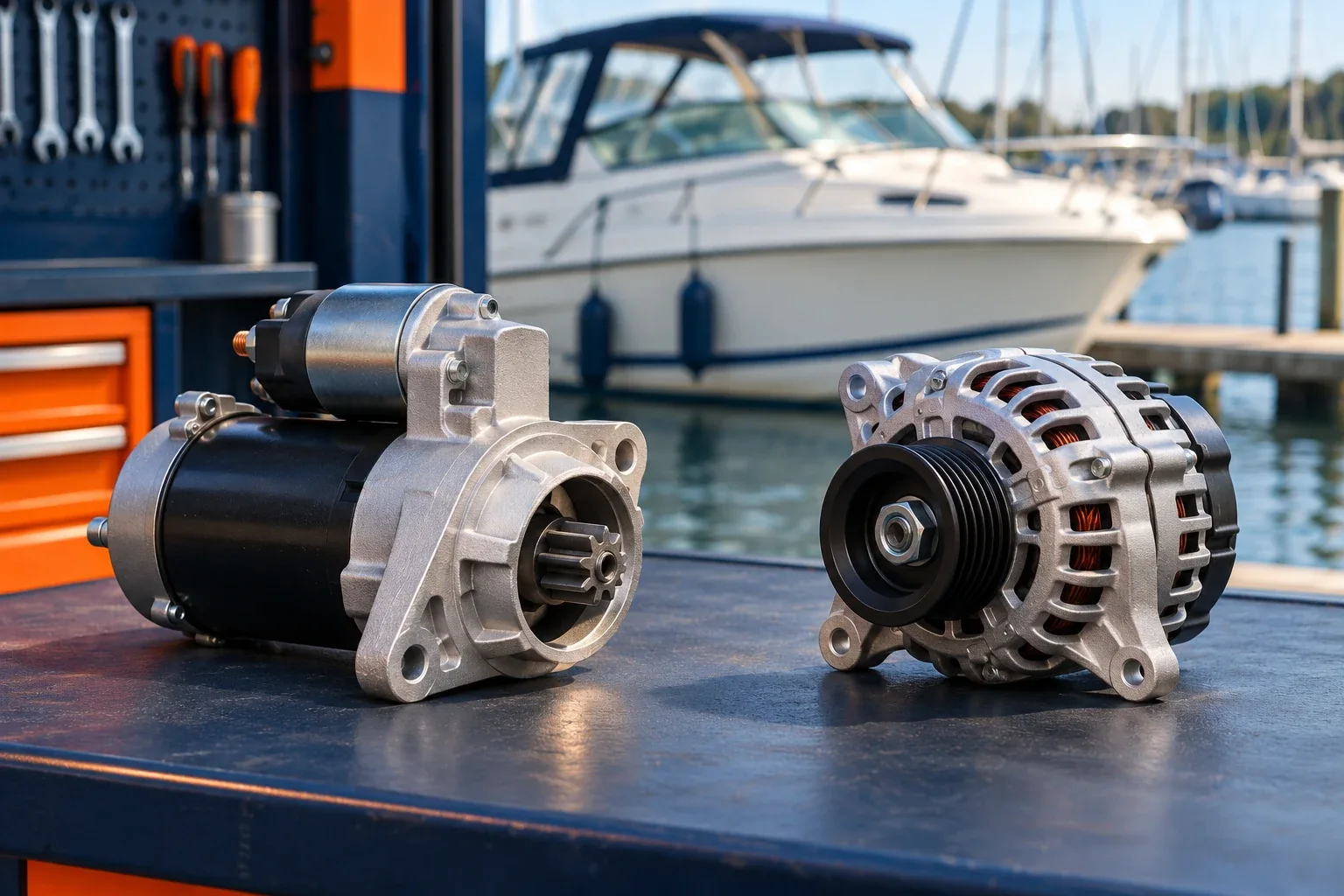
On a boat, the alternator is connected to the engine battery. The domestic battery is only recharged if a charge distribution device (split charge relay, diode splitter or DC-DC charger) links it properly to the charging circuit. When the starter battery is full and the domestic bank keeps going flat, the fault most often lies with that device or the wiring, rarely with the output of the alternator.
Key points
- A correct voltage at the engine battery proves nothing about the domestic bank's charge: measure each bank separately, with the engine running.
- The charge distribution device (split charge relay, diodes, DC-DC) affects charging as much as the alternator does.
- With a lithium battery, the current must be limited: the alternator cannot sustain maximum output for long, especially at low revs and in a hot engine compartment.
- Never switch off the engine battery isolator with the engine running if the alternator has no other charging path.
- When ordering, note the engine model and serial number, the alternator rating plate, the pulley and the type of regulation.
How does the alternator charge two battery banks?
The alternator output feeds the engine battery first, then a device sends a share of the current to the domestic bank. Four set-ups are found on board:
| Device | Principle | Point to watch |
|---|---|---|
| Battery isolator switch in the "1+2" (both) position | The two banks are connected directly, in parallel. | A flat battery draws on the other one. Different battery technologies and states of charge are poorly handled. Leaving the switch in the wrong position can leave the engine bank too weak to start. |
| Automatic split charge relay (voltage-sensitive relay) | A relay connects the banks when the voltage rises, then separates them when the engine stops. | The closing and opening thresholds must suit the technologies of both batteries. |
| Diode splitter | Each battery receives current through a diode that prevents reverse flow. | Each diode causes a voltage drop (around 0.5 to 0.7 V for a silicon diode). The domestic bank may stay undercharged if the installation does not compensate for this drop. |
| DC-DC charger | It draws from the engine battery or the alternator and recharges the domestic bank using its own charging profile. | Its maximum current sets the domestic bank's charge rate. It must be correctly sized and fuse-protected. |
On an insulated-return alternator, the negative return runs through a dedicated cable rather than the engine block. This set-up changes the way you measure and wire, as explained in our guide to choosing an insulated-return marine alternator.
Why is the engine battery full and the domestic bank low?
The cause is almost always on the path between the alternator and the domestic bank. The table lists the common symptoms.
| Symptom | Probable cause | Check |
|---|---|---|
| Engine battery at 13.5-14.8 V, domestic bank below 13 V with the engine running | Relay not closing, diode dropping too much voltage, corroded connection | Measure at each battery's terminals, then at the output of the device |
| Domestic bank flat in the morning despite several hours of engine running | Consumption higher than the energy received | Draw up an energy balance in Ah used and the current actually received |
| Charging voltage too low across the whole boat | Slipping drive belt, faulty regulator, degraded cable | Check the belt tension, then the alternator voltage with a multimeter |
| Weak or erratic charge warning light, smell of heat | Cable or terminal lug overheating, alternator overloaded | Check the temperature of the lugs and cables after a few minutes of charging |
How do you measure correctly?
With the engine running at cruising revs, measure the voltage at the alternator output, then at each battery's terminals, placing the probes on the posts and not on the lugs clamped over them. On a 12 V circuit, a charged battery at rest reads about 12.6 V and the charging voltage is between 13.5 and 14.8 V. Under heavy current draw, the voltage drop should not exceed about 0.5 V on the positive side and 0.3 V on the earth side. A larger gap points to a lug, cable or contact that needs redoing. For a 24 V circuit, expect about 25 V at rest and regulation around 28 V.
If all three readings are correct and the domestic bank still goes flat, the problem is an energy balance, not a faulty part. For the general method of interpreting readings, see our guide to alternator symptoms and charging voltage.
What alternator output do you need for the domestic bank?
The amperage shown on the plate corresponds to high revs and a hot alternator. At low revs, the available current is much lower, which matters for a boat that cruises at tickover or rarely moves. The same effect is found on HGVs, as explained in our article on insufficient charging at idle.
The calculation is done in three steps:
- Add up the Ah used per day: fridge, instruments, lighting, autopilot, pumps.
- Estimate the current the domestic bank actually receives from the engine, after the distribution device and at your usual revs.
- Divide: the result gives the engine running hours needed. Example: 100 Ah used with 25 A effectively received takes about 4 hours, more in practice.
A lead-acid battery accepts less current as it fills up, and the final stage of charging is slow. Solar or a shore power charger usefully supplements the engine. A bigger alternator does not fix an energy deficit if the engine runs little or at low revs.
What difference does a lithium battery make on board?
A lithium battery accepts a very high current and keeps accepting it for a long time. The alternator, for its part, produces close to its maximum throughout the charge, without the cooling of high revs. It heats up, even more so in a closed engine compartment.
Two precautions are needed:
- Limit the current with a DC-DC charger, or with a regulator that limits the amperage and monitors the alternator temperature.
- Plan for BMS disconnection: if the BMS disconnects the battery while the alternator is delivering current, the voltage can spike suddenly and damage the regulator and diodes. The installation must be able to cope with this situation.
The protection principle is detailed in the article on the lithium battery in a converted van and the DC-DC charger. Simply changing the alternator's amperage does not solve this issue.
Can you fit a more powerful alternator?
This is judged on the engine, not on amperage alone. Check in this order:
- the mounting and mounting centres: a more powerful alternator is often larger;
- the pulley, the number of grooves and the belt, which must transmit the load without slipping;
- the 12 V or 24 V voltage, and the type of regulation (internal or external, terminals);
- the ventilation of the compartment;
- the cables and fuses, sized by the installer according to the actual current and length.
After fitting, check the charge of both banks at several engine speeds, with the loads switched on, and record the part number and settings in the boat's documentation file.
What precautions should you take before working on it?
A battery gives off hydrogen when charging: ventilate and avoid any flame or spark. Remove rings and watches before touching the cables. A single switch does not always isolate every power source on board (shore power, solar, charger): disconnect each source before working. Never open the engine battery isolator with the engine running on an alternator that has no other charging path, as it risks being damaged.
Frequently asked questions
Can you charge a lead-acid battery and a lithium battery with the same alternator?
Yes, with a DC-DC charger that applies its own charging profile to each battery. Connecting them directly in parallel does not allow you to control the current or the protections.
Does a large domestic battery require a large alternator?
No. A large capacity recharges more slowly, but the current received is limited by the alternator, the distribution device and the engine running time. Do the Ah balance first.
Why is the voltage lower at the domestic bank than at the engine battery?
The distribution device (diode voltage drop, relay not closing) and resistive cables or lugs are the most frequent causes. Measure the voltage at each terminal with the engine running.
Should you keep an electrical diagram of the boat?
Yes. After successive additions (charger, solar, DC-DC), only an up-to-date diagram lets you know which path the current follows and where to measure. Note the part numbers and settings on it.
Find the right part
AutoTruck42, a French company based in the Loire, supplies new parts with a 2-year warranty. For a boat, these categories are the most useful:
Send us the original part number of the alternator, along with the engine model and serial number: we check compatibility before dispatch.
Further reading
Browse our catalogue of car and truck parts.