 Starter motor & alternator specialist
 Truck and van parts
 New parts with a 2-year warranty

 Contact an expert


Insulated-earth or case-earth marine alternator: why the difference matters on a boat, how to recognise the setup, wire the negative return and choose a replacement.
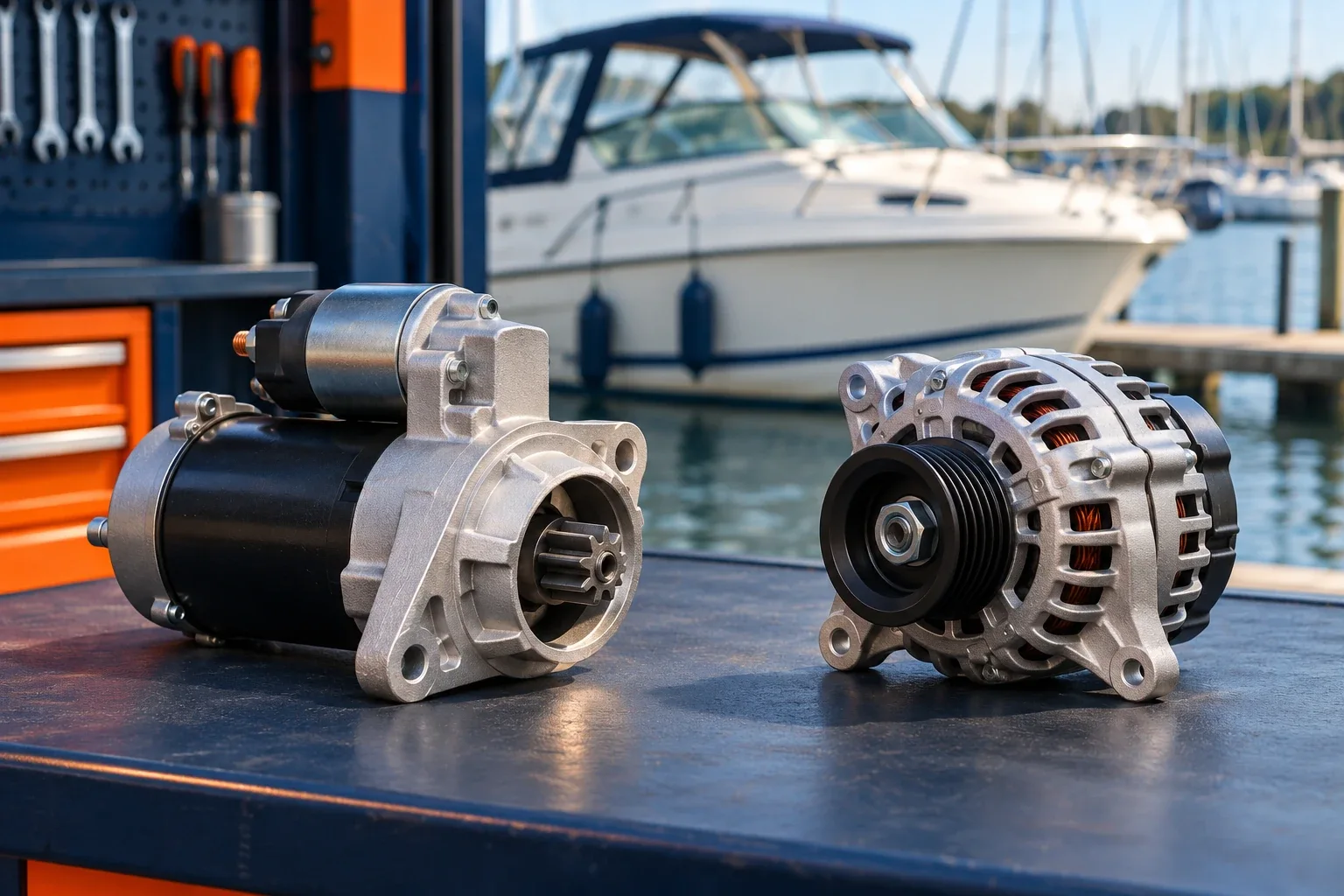
On a boat, many engines use an insulated-earth alternator: the negative does not pass through the housing and engine block but through a dedicated cable. Fitting a case-earth alternator instead, as on a car, can encourage corrosion and create faults that are hard to trace. Here is how to recognise the setup and choose the right alternator.
Key points
- An insulated-earth alternator has a separate negative terminal (B– or D–) cabled to the battery negative.
- It prevents charging current from flowing through the engine block and drive leg, limiting the risk of galvanic corrosion.
- A car alternator, even of the same size, is generally not insulated-earth.
- A marine alternator must also resist moisture and salt, and be ignition-protected if the compartment requires it.
Insulated earth or case earth: what is the difference?
| Type | Negative return | Usual use |
|---|---|---|
| Case earth | Through the alternator housing and engine block | Cars, vans, much machinery |
| Insulated earth | Through a dedicated negative terminal and cable | Boats, some special vehicles |
On an insulated-earth installation, no current should pass through the engine block. If a case-earth alternator is fitted, the block becomes a conductor again and currents can pass through the drive leg or propeller shaft.
How do you recognise your boat’s setup?
- Look for an insulated negative terminal on the alternator, in addition to the B+ terminal.
- Follow the cable from it: it should go directly to the battery negative or a negative busbar.
- Check the engine documentation: it often states “isolated ground” or “insulated earth”.
- Note the alternator part number, the engine and its serial number.
Other criteria for a marine alternator
- Voltage (12 V or 24 V) and amperage suited to onboard consumption.
- Mounting, pulley and belt alignment identical to the original.
- Protection against moisture and salt: treatment, sealed bearings.
- Ignition protection if the engine is petrol or regulations require it.
- Regulation: internal, external or multi-stage, depending on the installation.
Wiring and battery charging
The negative cable of an insulated-earth alternator must have the same cross-section as the positive cable, as it carries the same current. A corroded terminal or undersized cable causes voltage drop, heating and undercharging. Charging two banks (engine and domestic) is detailed in boat alternator and domestic batteries. For starting, the same isolation principle exists for starters: see marine or automotive starter.
To test charging, the method is the same as on a vehicle: testing a 12 V alternator with a multimeter, also measuring the voltage drop on the negative cable.
Frequently asked questions
Can a car alternator be fitted on a boat?
Not recommended: it is generally neither insulated-earth nor protected against moisture and salt. Choose a marine alternator with the same part number or a confirmed equivalent.
How do I know if my alternator is insulated-earth?
It has a separate negative terminal cabled to the battery negative. The engine documentation often states it.
What happens if I connect the negative terminal to the engine block?
The installation loses its isolation: current can flow through the block and drive leg, with a higher risk of corrosion.
Find the right part
AutoTruck42, a French company based in the Loire, supplies new marine alternators and starter motors with a 2-year warranty, as well as spare parts:
- Marine alternators for boat engines
- Marine starter motors for boat engines
- Alternator spare parts
- All new alternators
Send us your alternator number and the engine model and serial number: our technicians check compatibility before dispatch.
Browse our catalogue of car and truck parts.