 Starter motor & alternator specialist
 Truck and van parts
 New parts with a 2-year warranty

 Contact an expert


Three multimeter readings are enough to tell whether a 12 V alternator is charging: battery at rest, idle, loads on. Reference values, voltage drops and smart alternators.
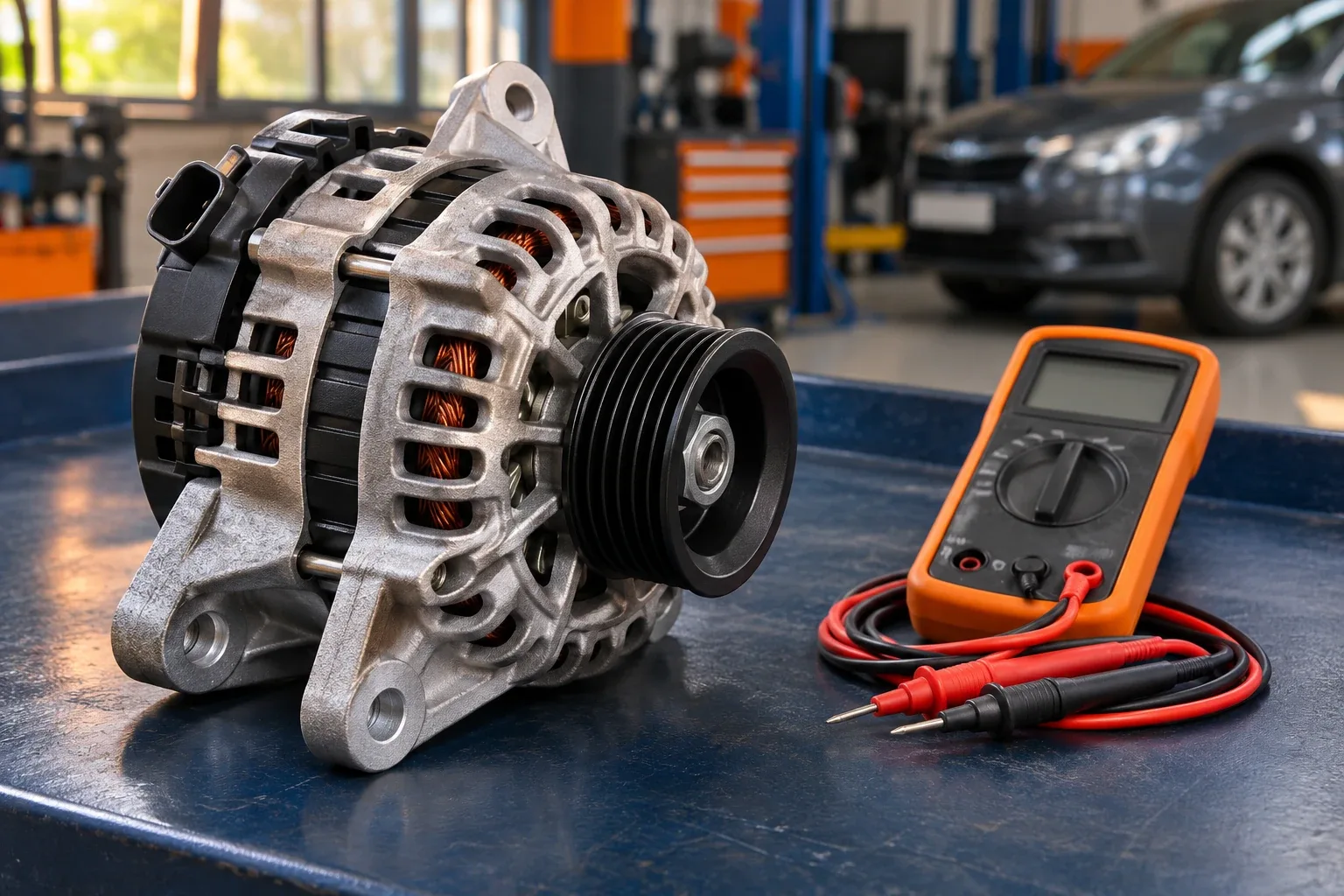
A multimeter is enough to tell whether a 12 V alternator is charging, provided you measure in the right place and under the right conditions. Here are the three readings to take, the reference values and the pitfalls, especially on alternators controlled by the ECU.
Key points
- Charged battery at rest: about 12.6 V. Engine running: usually 13.5 to 14.8 V.
- Measure at rest, at idle, then with loads switched on: a single reading is not enough.
- A voltage drop of more than 0.5 V on the B+ cable or more than 0.3 V on the earth distorts the diagnosis.
- On a smart alternator (LIN, COM), a low voltage may be intended: read the ECU set-point.
Preparing the measurement safely
- Set the multimeter to DC voltage (V⎓), 20 V range.
- Black lead in COM, red lead in the V socket: never in the A socket, which would short-circuit the battery.
- Keep hands, clothing and leads away from the belt and fan.
- If the terminals cannot be reached safely, measure at the connection points specified by the manufacturer.
The three readings to take
1. Battery at rest
With the engine off for at least an hour, measure across the battery terminals. About 12.6 V: battery charged. Below 12.2 V: recharge it before judging the alternator, otherwise the charging reading will be misleading.
2. Engine at idle, no loads
Start the engine and measure again. On a conventional circuit, the voltage should rise to between 13.5 and 14.8 V. If it stays close to 12.6 V, the alternator is not charging.
3. With loads switched on
Switch on the headlights, blower on full and demister, then raise the speed to about 2,000 rpm. The voltage should stay above roughly 13.2 V. If it collapses, the alternator lacks output or a connection fault is limiting the charge.
Reading the results
| Reading | Interpretation | Next step |
|---|---|---|
| Below 13 V with engine running | No charge or very weak charge | Check belt, fuse, connector, then regulator and brushes |
| 13.5 to 14.8 V, stable | Normal charging | Look elsewhere: battery, parasitic drain |
| Above 15 V | Overcharging, faulty regulator | Stop testing: risk to the battery and electronics |
| Voltage falls with loads on | Insufficient output or poor connection | Measure the B+ and earth voltage drops |
| Voltage varies on its own | Smart alternator or intermittent contact | Read the ECU set-point, check the terminals |
Measuring voltage drops
With the engine running and loads on, place the multimeter between the alternator B+ terminal and the battery positive terminal: above 0.5 V, the cable or its terminals are at fault. Do the same between the alternator housing and the battery negative terminal: above 0.3 V, the earth is faulty. These faults give the same symptoms as a worn alternator and cost far less to repair.
Smart alternators
On many recent vehicles, the ECU controls the charging voltage according to battery condition, temperature and deceleration. A reading of 12.8 V at a given moment can then be normal. Only reading the set-point and charging data allows a conclusion: see LIN or COM alternator: identifying the regulation.
If the light comes on while driving, start with battery light on while driving. If the battery drains overnight, see battery draining overnight. On a 24 V circuit, regulation is around 28 V: see 24 V truck alternator.
Frequently asked questions
Can you test an alternator without removing it?
Yes: voltage readings are taken on the vehicle. A test bench is still useful to measure actual output and ripple.
What voltage should a 12 V alternator give?
Usually 13.5 to 14.8 V with the engine running. On a smart alternator, the value varies deliberately according to the ECU set-point.
Can a multimeter detect a faulty rectifier?
Not always. An open diode can leave a correct no-load voltage but reduce output; a ripple measurement or bench test is more reliable.
Find the right part
AutoTruck42, a French company based in the Loire, supplies new 12 V alternators with a 2-year warranty, as well as regulators, rectifiers and pulleys:
- Alternators for cars and vans
- Alternators for tractors and farm machinery
- Alternator spare parts
- All new alternators
Send us the number of your original alternator: our technicians check compatibility before dispatch.
Further reading
Browse our catalogue of car and truck parts.