 Starter motor & alternator specialist
 Truck and van parts
 New parts with a 2-year warranty

 Contact an expert


Faulty starter: replace the solenoid, brushes, pinion drive, bushes or the complete starter? Diagnosis, pros and cons of each option, and when a new starter is the best choice.
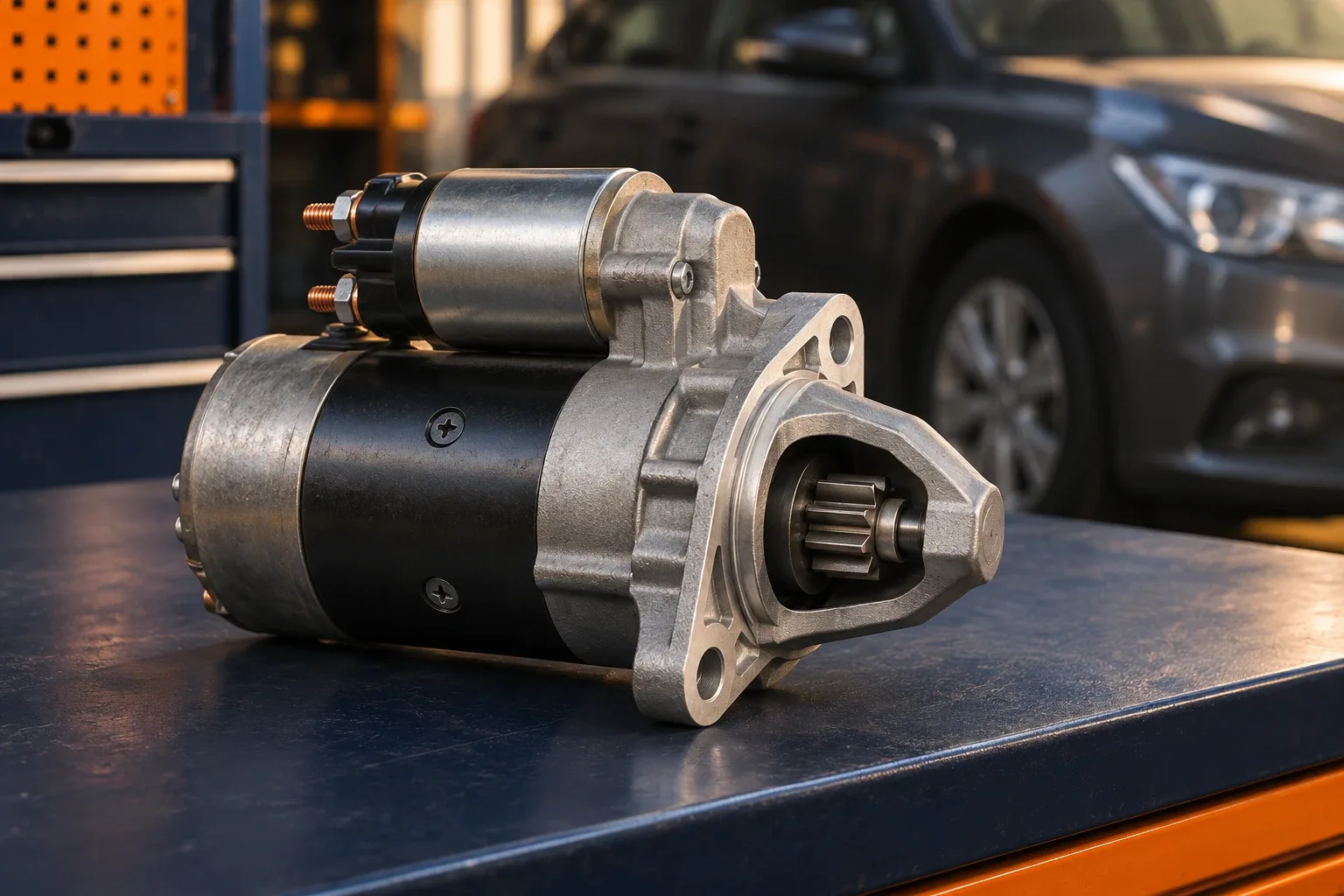
A starter has a few main wear parts: the solenoid and its contacts, the brushes, the bushes or bearings, and the pinion drive with its overrunning clutch. When it fails, sometimes only the faulty part can be replaced. But this only makes sense if the rest of the starter is in good condition and the part is available. Here is how to decide.
Key points
- Solenoid, brushes, bushes and pinion drive are a starter’s main wear parts.
- Replacing one part only makes sense if the rest of the starter is sound.
- Removal, diagnosis and downtime often weigh more than the price of the parts.
- A new starter comes with all parts new and a full warranty.
Which part for which symptom?
| Symptom | Likely part | Repairable alone? |
|---|---|---|
| Click without rotation, correct voltage | Solenoid contacts | Yes on some models |
| Slow or intermittent cranking | Worn brushes | Yes if available |
| Starter heats up, rubs | Bushes or bearings | Yes, full strip-down |
| Spins freely | Pinion drive or overrunning clutch | Yes |
| Burning smell, no rotation | Armature or field windings | Rarely worthwhile |
Before dismantling: confirm the diagnosis
- Check the battery: 12.6 V at rest, not below 9.6 V while cranking.
- Measure voltage at the starter’s main terminal during the attempt.
- Check command voltage at the solenoid’s small terminal.
- Listen: single click, slow rotation, whine or grinding.
- Check the flywheel ring gear if the starter spins freely.
Limits of a partial repair
Replacing the solenoid solves nothing if the brushes are worn; changing the brushes is pointless if the bushes have let the armature rub. On a well-used starter, parts wear together and a partial repair often leads to a second removal a few months later. In addition, some parts are no longer made for older starters, or cost almost as much as a complete unit.
When to choose a new starter
- Several parts are worn at once.
- The armature or windings have overheated.
- The vehicle or machine cannot be left idle.
- The exact spare part cannot be found.
- You want a full warranty on the whole starter.
Further reading
Diagnosing a click without rotation is covered in starter clicks but will not turn. The pinion drive and ring gear are covered in starter spinning freely. Heat-related faults are in starter failing when hot. The same reasoning applies to alternators: repair or replace an alternator.
Frequently asked questions
Can just the starter solenoid be replaced?
On some starters, yes, if the diagnosis points to it and the exact part is available. Check the brushes too.
How long do starter brushes last?
It depends heavily on use: number of starts, engine size, climate. Vehicles that start frequently wear them faster.
Is a repaired starter as reliable as a new one?
Only if all wear parts have been replaced. Otherwise, the parts left in keep their original wear.
Find the right part
AutoTruck42, a French company based in the Loire, supplies new starter motors with a 2-year warranty for cars, vans, trucks, machinery and tractors:
- Starter motors for cars and vans
- 24 V starter motors for trucks and machinery
- Starter motors for tractors
Send us your starter part number: we will tell you the equivalent new starter and check compatibility before dispatch.
Further reading
Browse our catalogue of car and truck parts.