 Starter motor & alternator specialist
 Truck and van parts
 New parts with a 2-year warranty

 Contact an expert


A 24 V hydraulic excavator cranking sluggishly: unbalanced batteries, cables and earths, battery isolator, pre-heating or worn starter. The checks to find the cause quickly.
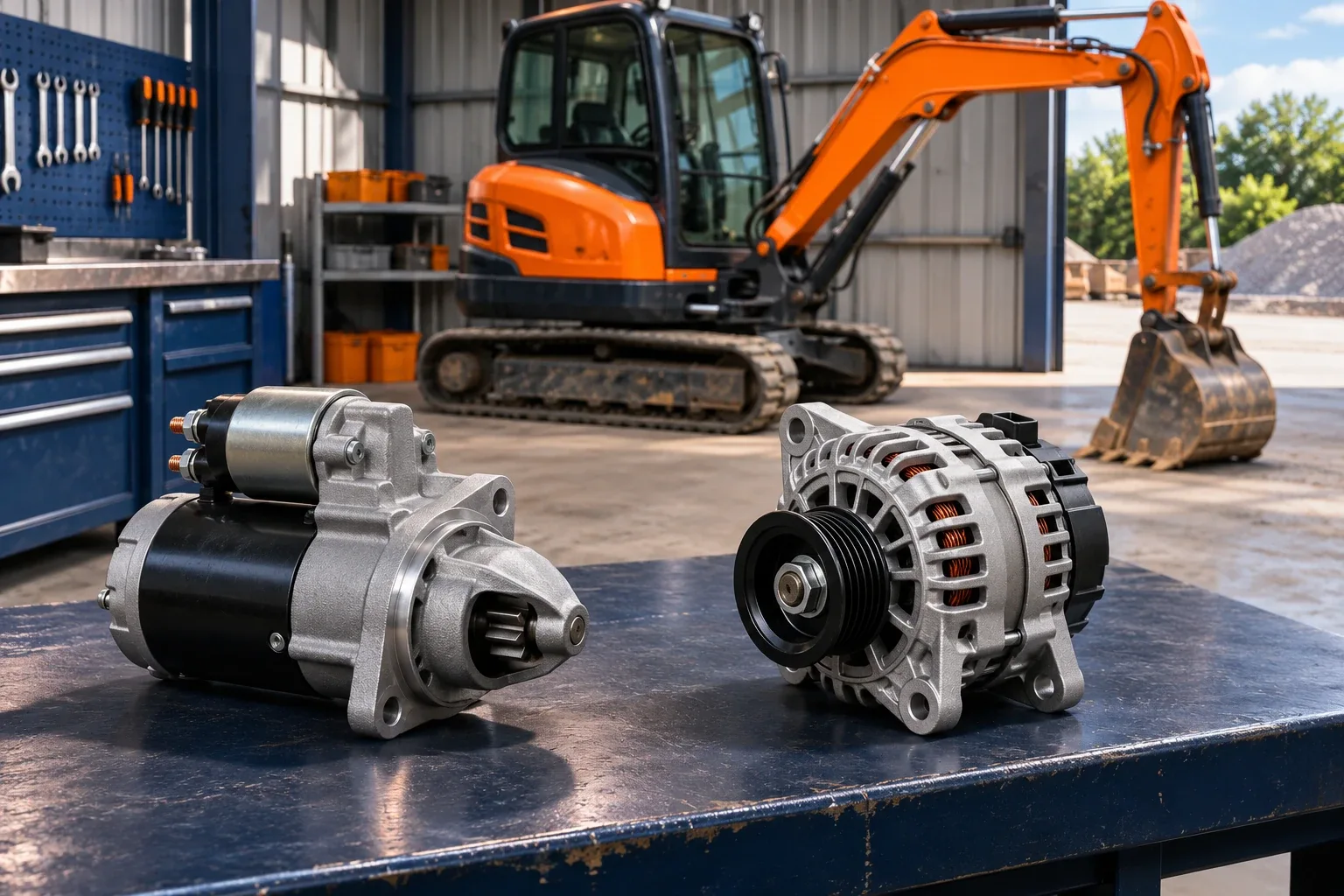
On a hydraulic excavator, the 24 V starter must crank a large diesel engine, often cold and sometimes after several days idle on site. When cranking slows, the cause may lie in the batteries, wiring, battery isolator, pre-heating or the starter itself. A methodical check avoids replacing the wrong part.
Key points
- On 24 V, a single weak battery slows the whole cranking process: measure them separately.
- Long cables, the battery isolator and earths on an excavator often cause voltage drops.
- While cranking, voltage should not drop below roughly 19 to 20 V.
- If voltage at the starter is good but cranking stays slow, the starter is worn.
Why an excavator cranks slowly
An excavator starter draws a very high current when cranking. This current flows through two batteries in series, a bridge cable, an isolator, long cables to the engine and the chassis earth. Every corroded or loose connection adds resistance that drops the voltage. Add to that thick oil in cold weather and normal starter wear after thousands of hours.
Checks in order
- Measure each battery at rest: about 12.6 V each.
- While cranking, measure each battery: a large difference identifies the weak one.
- Measure total voltage while cranking: it should not drop below roughly 19 to 20 V.
- Check the bridge between batteries, the isolator and terminals (heating, corrosion).
- Measure voltage on starter terminal 30 while cranking and compare it with the batteries.
- Check the earth between engine, chassis and upper structure.
Causes and their clues
| Cause | Clue |
|---|---|
| Unbalanced batteries | Voltage difference between the two while cranking |
| Worn isolator | Heating, voltage drop at its output |
| Chassis–engine earth | Voltage drop on the negative return |
| Faulty pre-heating | Engine cranks but is slow to fire, white smoke |
| Worn starter | Correct voltage at the starter, slow cranking |
Pre-heating
If the engine cranks at normal speed but starts with difficulty, the starter is not to blame. Excavators use glow plugs or an intake grid heater. A faulty element or a failed pre-heat relay gives long starts, especially in winter. The same reasoning is detailed for road diesels in diesel cold starting.
Replacing the starter and protecting charging
To choose an equivalent 24 V starter, compare power, number of teeth, rotation and mounting: see 24 V starter: power, teeth, equivalence. The role of the two batteries is covered in 24 V starter and two batteries. Finally, an excavator that starts badly sometimes has a charging fault: hydraulic excavator alternator.
Frequently asked questions
My excavator cranks slowly but the batteries are new, why?
Check the bridge between batteries, the isolator, cables and earth. If all is good, the starter is probably worn.
What is the minimum cranking voltage on a 24 V excavator?
As a rule, voltage should not drop below roughly 19 to 20 V while cranking.
Should both batteries be replaced together?
Yes, it is recommended: a new battery paired with a worn one creates an imbalance that quickly wears both.
Find the right part
AutoTruck42, a French company based in the Loire, supplies new 24 V starter motors and alternators with a 2-year warranty for hydraulic excavators and construction machinery:
Send us your starter part number or the excavator model and serial number: we check compatibility before dispatch.
Further reading
Browse our catalogue of car and truck parts.