 Starter motor & alternator specialist
 Truck and van parts
 New parts with a 2-year warranty

 Contact an expert


Finding the starter for a JCB 3CX, 4CX or Case 580, 590 backhoe loader: Perkins, JCB or FPT engine, 12 or 24 V, original part number, power, pinion and mounting.
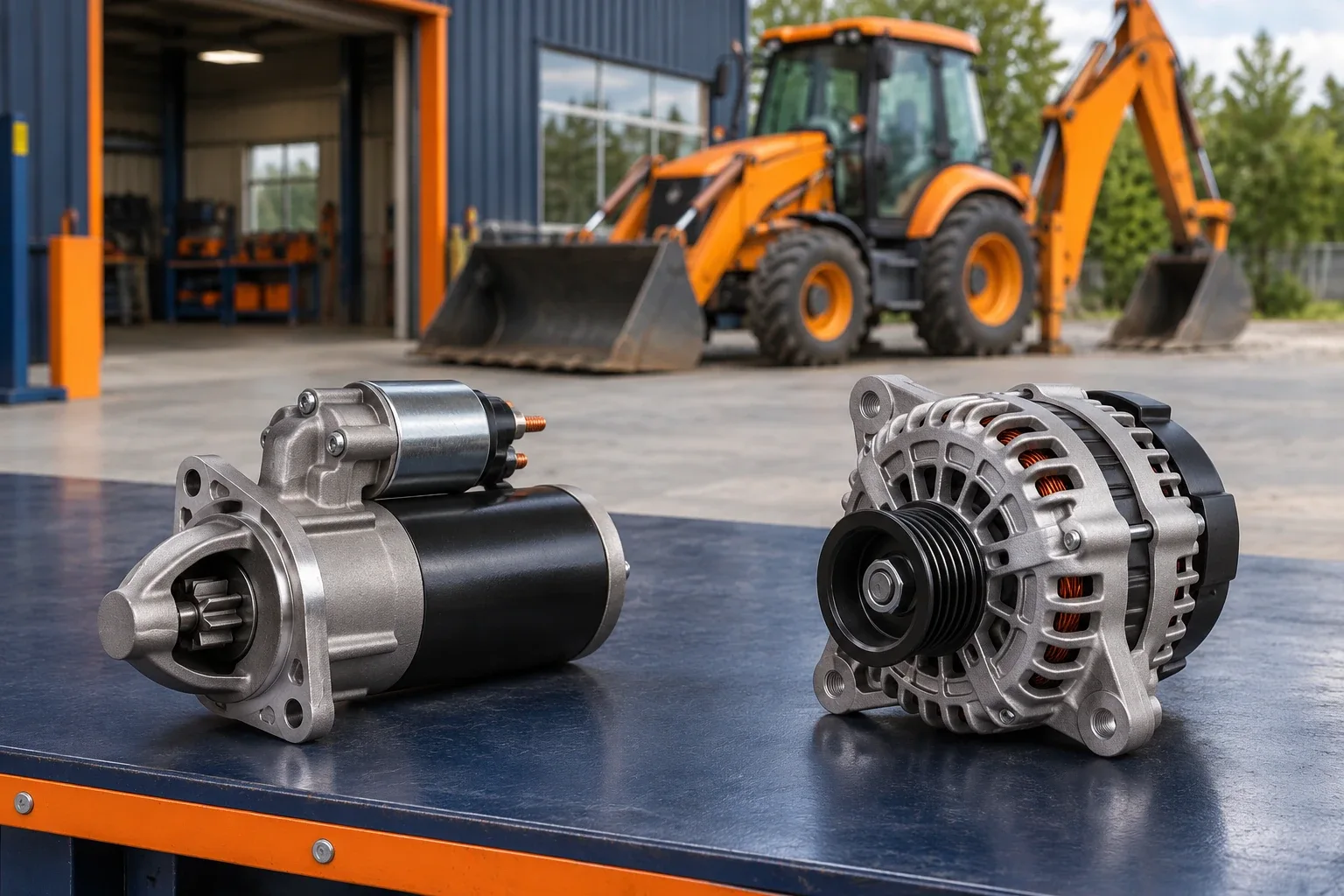
The backhoe loader is a versatile machine that often starts in cold, mud and dust. The most common models, such as the JCB 3CX or Case 580, have had several generations of engines: Perkins, then JCB or FPT engines depending on the brand. The starter therefore depends on year and engine. Here is how to identify it correctly.
Key points
- A backhoe starter depends on the engine: Perkins on many older models, then JCB Dieselmax/Ecomax or FPT depending on the brand.
- Depending on year and market, the electrical system is 12 V or 24 V.
- The number stamped on the starter and the machine serial number are the key information.
- Power, number of teeth, rotation and mounting must match exactly.
Engines in common backhoe loaders
| Machine | Engines found |
|---|---|
| Older JCB 3CX / 4CX | Perkins |
| Recent JCB 3CX / 4CX | JCB Dieselmax then Ecomax |
| Case 580 / 590 | Case or FPT engines depending on generation |
| Caterpillar 428 / 432 | Perkins or Caterpillar depending on series |
| Volvo, Komatsu, New Holland | Own engines or Perkins depending on model |
These indications are general: always check the engine plate and machine serial number.
Collecting the right information
- Read the part number and voltage on the starter plate.
- Note the backhoe model and serial number (data plate).
- Identify the engine: make, type and serial number.
- Count the pinion teeth and note the direction of rotation.
- Photograph the flange, terminals and connector.
12 V or 24 V?
A backhoe with two 12 V batteries in series runs on 24 V. A single battery generally means 12 V. Fitting a starter of the wrong voltage destroys it immediately or makes it ineffective. On a 24 V system, the condition of both batteries and the bridge between them is essential: see 24 V starter and two batteries.
Common faults
- Click without rotation: battery, cables, earth or worn solenoid.
- Slow cranking when hot: worn bushes, tired starter.
- Starter spinning freely: pinion drive or ring gear.
- Flooded or corroded starter after washing or working in wet areas.
Removal and refitting: precautions
- Disconnect the battery (both on 24 V) before any work.
- Mark and photograph each wire before disconnecting it.
- Clean the housing mating face and check the ring gear through the opening.
- Tighten the mountings to the specified torque and refit any shims.
- Retighten the main and control terminals, then do a start test.
Related articles
The alternator on the same backhoe is identified the same way: JCB, Case backhoe alternator. Equivalence criteria for 24 V starters are covered in 24 V starter: power, teeth, equivalence. For smaller machines: Kubota, Yanmar mini excavator starter. And for 24 V excavators: 24 V excavator cranking slowly.
Frequently asked questions
Does my JCB backhoe have a Perkins engine?
Older models generally do. More recent ones use JCB engines. The engine plate confirms it.
How do I know if my backhoe is 24 V?
Two 12 V batteries connected in series mean a 24 V system. The starter label also states its voltage.
Can a more powerful starter be fitted?
Slightly higher power is possible if all mounting dimensions and the pinion are identical.
Find the right part
AutoTruck42, a French company based in the Loire, supplies new starter motors and alternators with a 2-year warranty for backhoe loaders and construction machinery:
Send us your starter part number or the backhoe model and serial number: we check compatibility before dispatch.
Browse our catalogue of car and truck parts.