 Starter motor & alternator specialist
 Truck and van parts
 New parts with a 2-year warranty

 Contact an expert


A stop-start vehicle restarts hundreds of times a day: reinforced starter, EFB or AGM battery, electronic management. Why a standard starter is not suitable and how to choose the right one.
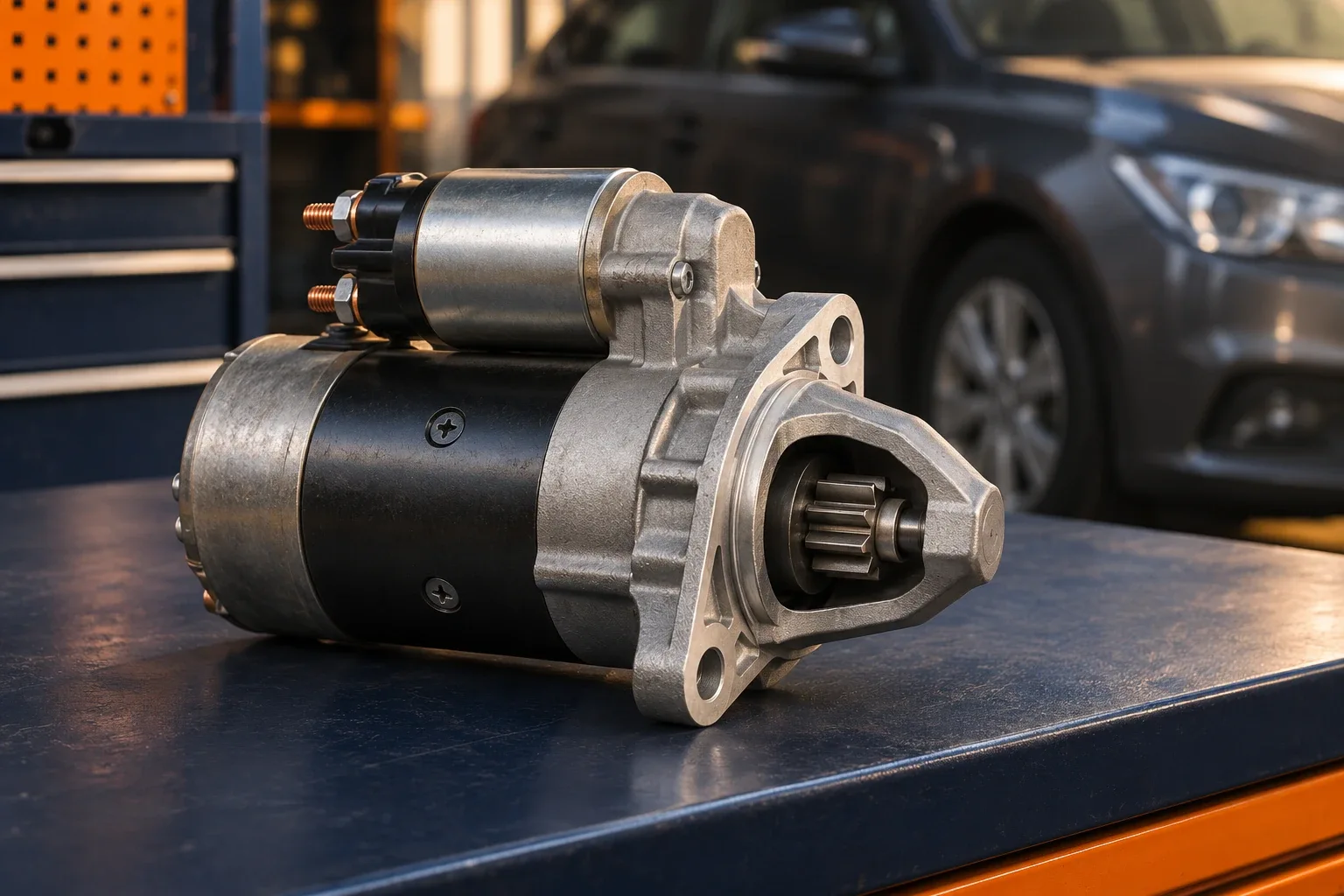
On a vehicle with stop-start, the engine stops at every red light and restarts as soon as the driver releases the brake or presses the clutch. The starter therefore works far harder than a standard one. It is designed accordingly, and so is the battery. Fitting a standard part instead leads to early failures.
Key points
- A stop-start starter is designed for a far higher number of starts than a standard starter.
- Its bushes, brushes, pinion drive and solenoid are reinforced.
- The battery is EFB or AGM, and a sensor monitors its state of charge.
- A standard starter fitted to a stop-start vehicle wears prematurely, even if it fits perfectly.
What changes on a stop-start starter
| Part | Standard starter | Stop-start starter |
|---|---|---|
| Number of starts | Standard use | Very high, intensive use |
| Bushes and bearings | Standard | Reinforced, long life |
| Brushes | Standard | Larger, slow wear |
| Pinion drive and clutch | Standard | Reinforced for repeated engagement |
| Solenoid | Standard | Reinforced contacts |
Battery and electronic management
Stop-start relies on a battery able to withstand repeated partial discharge cycles: EFB (enhanced flooded battery) or AGM (absorbed glass mat). A sensor on the negative terminal measures state of charge and temperature. If the battery is judged too weak, the system disables stop-start. After a battery replacement, registering the new battery in the ECU is often required. The alternator, often controlled, also takes part in this management: see LIN/COM controlled alternator.
Signs of a tired stop-start starter
- Stop-start no longer activates although the battery is in good condition.
- Slower or noisier restarts after stopping at lights.
- Click without rotation or grinding on restart.
- Dashboard warning about the starting system.
Choosing the right replacement starter
- Note the original part number on the starter label.
- Check that the part offered is indeed a stop-start model.
- Check power, number of pinion teeth and direction of rotation.
- Compare mounting and control connector.
- Check the battery: a worn EFB or AGM battery will strain the new starter.
Other useful articles
If the starter clicks without turning, see starter clicks but will not turn. For recent vans, often fitted with stop-start: Master, Ducato, Transit, Sprinter starter. To understand other possible faults: symptoms of a failing starter. And if a new starter does not work: new starter not working.
Frequently asked questions
Can a standard starter be fitted to a stop-start vehicle?
Not recommended: it is not designed for such a high number of starts and will wear prematurely.
Why has stop-start stopped working?
Often because of the battery (charge, condition, registration). The starter is only at fault if restarts become difficult.
Is a special battery needed?
Yes, an EFB or AGM battery as originally fitted. A standard battery shortens the system’s life.
Find the right part
AutoTruck42, a French company based in the Loire, supplies new starter motors with a 2-year warranty, including stop-start models for cars and vans:
Send us your starter part number or vehicle details: we check that it is a compatible stop-start model.
Further reading
Browse our catalogue of car and truck parts.