 Starter motor & alternator specialist
 Truck and van parts
 New parts with a 2-year warranty

 Contact an expert


The starter spins, you can hear it, but the engine does not crank: worn overrunning clutch, shift fork, pinion or flywheel ring gear. How to find the cause and what to replace.
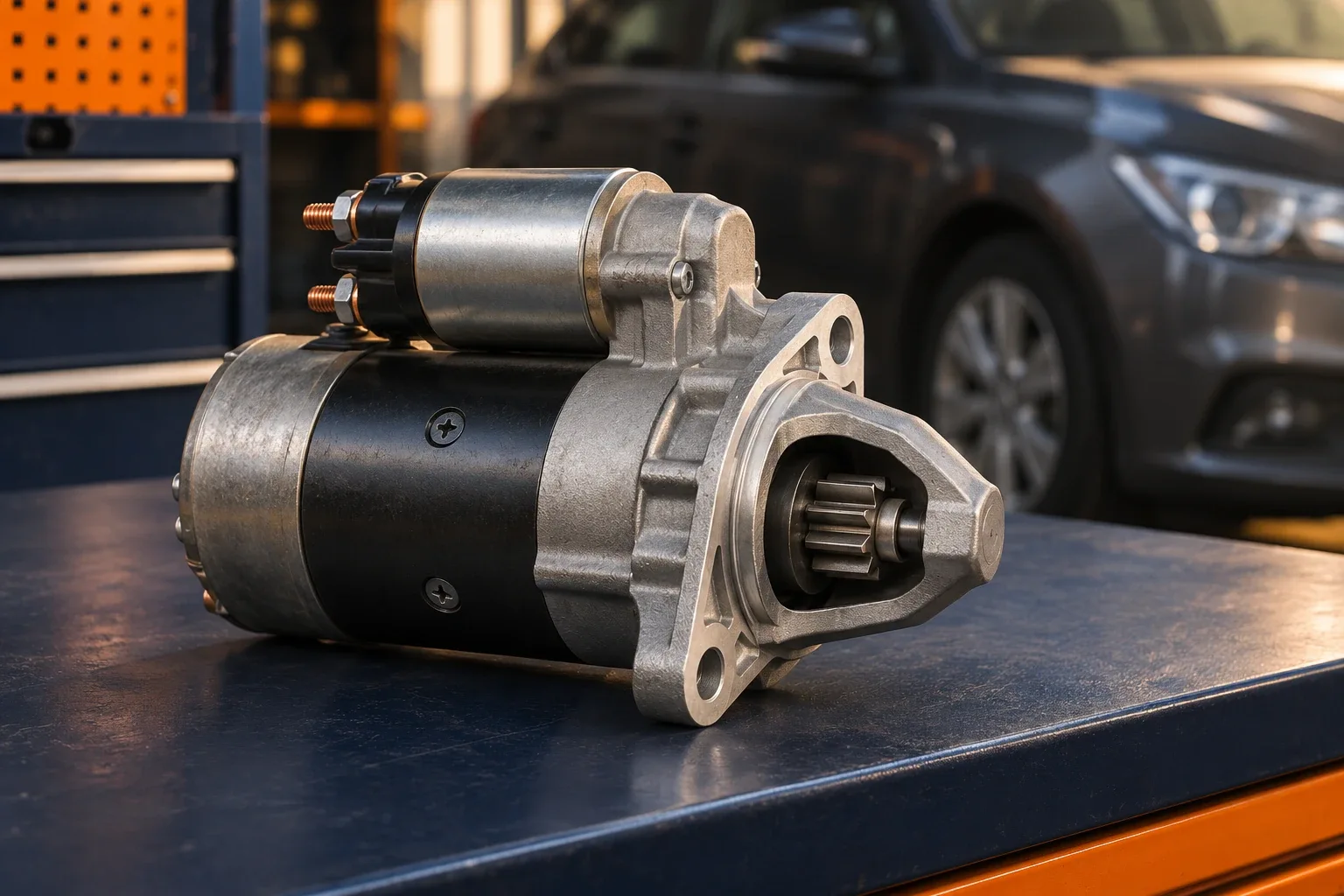
You can hear the starter spinning, sometimes very fast and with a whine, but the engine stays still. In this case the starter’s electric motor is working: it is the drive to the flywheel that fails. The pinion drive, its pinion or the flywheel ring gear is at fault. Here is how to tell them apart.
Key points
- A starter spinning freely has a healthy electric motor: the problem is mechanical, between pinion and ring gear.
- A slipping overrunning clutch in the pinion drive is the most common cause.
- A metallic grinding noise when starting often means worn teeth on the pinion or ring gear.
- If the flywheel ring gear is damaged, replacing only the starter is not enough.
How engagement works
When starting, the solenoid pushes the pinion drive forward via a shift fork. The pinion engages the flywheel ring gear, then the electric motor turns and cranks the engine. An overrunning clutch built into the drive then protects the starter when the engine fires and spins faster than it. If any of these parts fails, the starter spins without cranking the engine.
Possible causes
| Cause | Typical symptom |
|---|---|
| Slipping overrunning clutch | Starter spins fast and whines, engine still |
| Broken shift fork or solenoid not pushing | Starter spins with no engagement noise |
| Worn pinion | Grinding, random engagement |
| Worn or broken ring gear | Problem always at the same position, metallic noise |
| Loose starter or missing shim | Partial engagement, teeth damaged quickly |
Step-by-step diagnosis
- Listen: a high whine with no engagement noise points to the overrunning clutch or shift fork.
- Remove the starter and turn the pinion by hand: it should turn freely one way and lock the other.
- Check the pinion teeth: if rounded or chipped, the drive must be replaced.
- Through the starter opening, inspect the ring gear at several positions by turning the engine by hand.
- Check the starter mounting bolts are tight and any shims are present.
Pinion drive only, complete starter or ring gear?
If only the pinion drive is worn and the rest of the starter is sound, a replacement drive may be enough. But on a well-used starter, bushes, brushes and solenoid are also tired: a new starter avoids a second removal. If the ring gear is damaged, it must be replaced or the flywheel changed, otherwise the new starter will be damaged in turn. To compare options, see solenoid, brushes or complete starter.
Similar symptoms not to confuse
A starter that clicks without turning calls for a different, electrical diagnosis: see starter clicks but will not turn. On tractors, the choice between a reduction-gear and a direct-drive starter also affects engagement: see reduction-gear or direct-drive starter. On trucks, the number of pinion teeth is a key equivalence criterion: see truck starter: teeth and equivalence.
Frequently asked questions
The starter spins but the engine does not start, is it the starter?
Often the starter’s pinion drive, but also check the flywheel ring gear before fitting a new part.
Can the pinion drive be replaced on its own?
Yes, if the rest of the starter is sound. On an old starter, a complete unit is often more cost-effective.
How do I know if the ring gear is damaged?
Inspect its teeth through the housing opening while turning the engine by hand: worn or missing teeth in one area mean the ring gear must be replaced.
Find the right part
AutoTruck42, a French company based in the Loire, supplies new starter motors with a 2-year warranty for cars, vans, trucks, machinery and tractors:
- Starter motors for cars and vans
- 24 V starter motors for trucks and machinery
- Starter motors for tractors
Send us your starter part number and the number of pinion teeth: we check compatibility before dispatch.
Further reading
Browse our catalogue of car and truck parts.