 Starter motor & alternator specialist
 Truck and van parts
 New parts with a 2-year warranty

 Contact an expert


A single click, slow cranking or no response at all: before blaming the starter motor, check the battery, earth connections and the control circuit. Diagnosis method and criteria for ordering the right part.
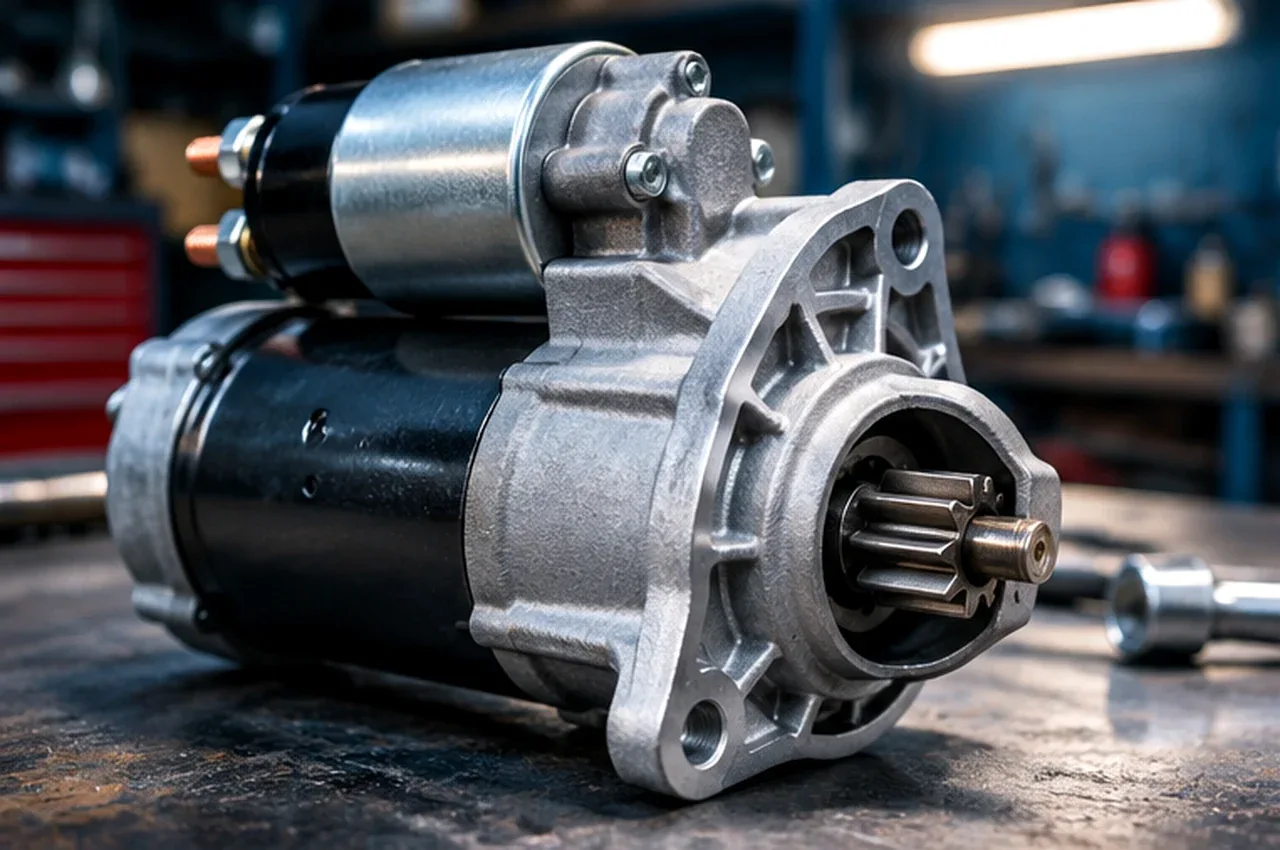
A sharp click when you turn the key, an engine that cranks more and more slowly, or no reaction at all: these symptoms point to the starter motor, yet half the time the cause lies elsewhere. A tired battery, a corroded earth or an interrupted control circuit produce exactly the same signs. Here is how to decide before buying a part, and then how to choose the right part number.
Key points
- A single click does not prove the starter is dead: first check the battery under load and the voltage drops.
- During cranking, a healthy 12 V battery stays above roughly 9.6 V; below that, the problem is the power supply.
- A starter that spins freely without turning the engine points to the drive or the ring gear: stop trying.
- To order, start from the number stamped on the original part, then check voltage, power, number of teeth and mountings.
How does a starter motor work?
The starter is a powerful electric motor fed directly by the battery. When starting is allowed, the solenoid pushes the drive pinion into the flywheel ring gear and closes the main power circuit. The electric motor then turns the engine until it runs on its own, and the pinion disengages. The current draw is very high: several hundred amps on a car, more on a 24 V truck. That is why the slightest poor connection shows up immediately when starting.
Which symptoms point to the starter motor?
A single click and nothing else
The solenoid engages but the motor does not turn. This may come from worn internal contacts, but also from a voltage that collapses when the current is drawn. Our guide starter clicks but does not crank lists the checks in order.
Rapid repeated clicking
This is almost always the power supply: flat battery, loose terminal or damaged earth cable. The solenoid engages, the voltage drops, it releases, and the cycle starts again.
Slow cranking
Weak battery, resistance in the cables, worn starter (brushes, armature) or oil that is too thick in very cold weather. On a diesel, also think about the glow plugs: see diesel hard to start when cold.
The starter spins freely
The electric motor turns but does not drive the engine: worn freewheel, pinion or ring gear. Insisting damages the flywheel ring gear. More details in starter spinning without engaging.
No sound at all
First find out whether the control signal arrives: relay, fuse, automatic gearbox or clutch switch, immobiliser. With no voltage on the control terminal, replacing the starter will not help.
Failure only when hot
Resistance increases with temperature and a worn starter can fail when the engine is hot. See starter fails when hot but works when cold.
In what order should you diagnose?
- Battery at rest. A charged 12 V battery reads about 12.6 V with the engine off (25.2 V for a 24 V system with two batteries). Below 12.4 V, recharge before any other test.
- Battery under load. During cranking, the voltage should not fall below about 9.6 V on a 12 V system. A collapsing battery distorts every other check.
- Voltage drops. While cranking, measure between the battery positive terminal and the starter power terminal, then between the negative terminal and the starter housing. A drop above about 0.5 V on the positive side or 0.3 V on the earth side means a cable or connection needs attention.
- Control circuit. Check for voltage on the solenoid control terminal when starting is requested. If there is none, look upstream (relay, safety switches, immobiliser).
- Starter motor. If supply and control are correct and the starter does not turn or turns badly, the part is at fault.
Never bridge the starter terminals with a tool to make it turn: risk of short circuit, burns and the vehicle starting in gear.
Symptom, likely cause and check
| Symptom | Most likely cause | First check |
|---|---|---|
| Single click, no rotation | Insufficient voltage or solenoid | Battery under load, voltage drop |
| Rapid clicking | Flat battery, poor contact | Battery charge, terminal tightness |
| Slow cranking | Battery, cables or worn starter | Voltage while cranking |
| Spinning freely | Drive or ring gear | Removal and mechanical check |
| No sound | No control signal | Voltage on the control terminal |
| Grinding on start | Worn pinion or ring gear | Stop trying, inspect |
Repair or replace the starter?
On some models the solenoid or brushes can be replaced. In practice, when several components are worn, a complete replacement is more reliable and often cheaper in workshop time. The guide solenoid, brushes or complete starter helps you decide.
How to choose the right part number?
The vehicle model alone is not enough: the same engine may be fitted with several starters depending on the gearbox, year or options (Stop & Start, air conditioning, market). Proceed as follows:
- Note the number stamped on the original part (Bosch, Valeo, Denso, Mitsubishi Electric, Prestolite…) and, if possible, the vehicle manufacturer number.
- Check the voltage: 12 V for cars, vans and most tractors; 24 V for trucks and many construction machines.
- Check the power in kW, the number of pinion teeth and the direction of rotation.
- Compare the mountings, spigot diameter and terminal positions.
- On a Stop & Start vehicle, use a reinforced starter designed for this system: see Stop & Start starter motors.
A slightly different power rating for the same base part number is generally compatible; a different number of teeth or different mountings, never.
After fitting: the checks to carry out
Tighten the cables to the specified torque, clean the earth contact surfaces and check the battery. A new starter that clicks or turns badly almost always reveals a power supply problem that is still present: see new starter not working after fitting.
Frequently asked questions
Is it the battery or the starter that clicks?
The click comes from the solenoid, but the cause is often the battery. If the voltage falls below 9.6 V during the test, deal with the battery and cables first.
Can you start with a failing starter?
Sometimes by tapping the housing, which frees the brushes for a moment, but that is an emergency fix that announces a final failure. Plan the replacement.
How long does a starter motor last?
It depends mainly on the number of starts: a delivery vehicle that starts fifty times a day wears its starter far faster than one that drives long distances between stops.
Is a 24 V starter diagnosed the same way?
Yes, with doubled values and particular attention to both batteries and their link cable. See 24 V truck starter clicking.
Find the right part
AutoTruck42 supplies new starter motors with a 2-year warranty for every use. Have the number of your original part to hand and browse the matching range:
- Starter motors for cars and vans (12 V)
- Starter motors for trucks and construction machines (24 V)
- Starter motors for agricultural tractors
- Starter motors for IC forklift trucks
- All new starter motors
Unsure about a cross-reference? Our technicians check compatibility from your original part number before shipping.
Further reading
Browse our catalogue of car and truck parts.