 Starter motor & alternator specialist
 Truck and van parts
 New parts with a 2-year warranty

 Contact an expert


Battery light on, flat battery or belt noise: before replacing the alternator, check the battery, the belt drive and the charging voltage. Diagnostic method and criteria for ordering the right part number.
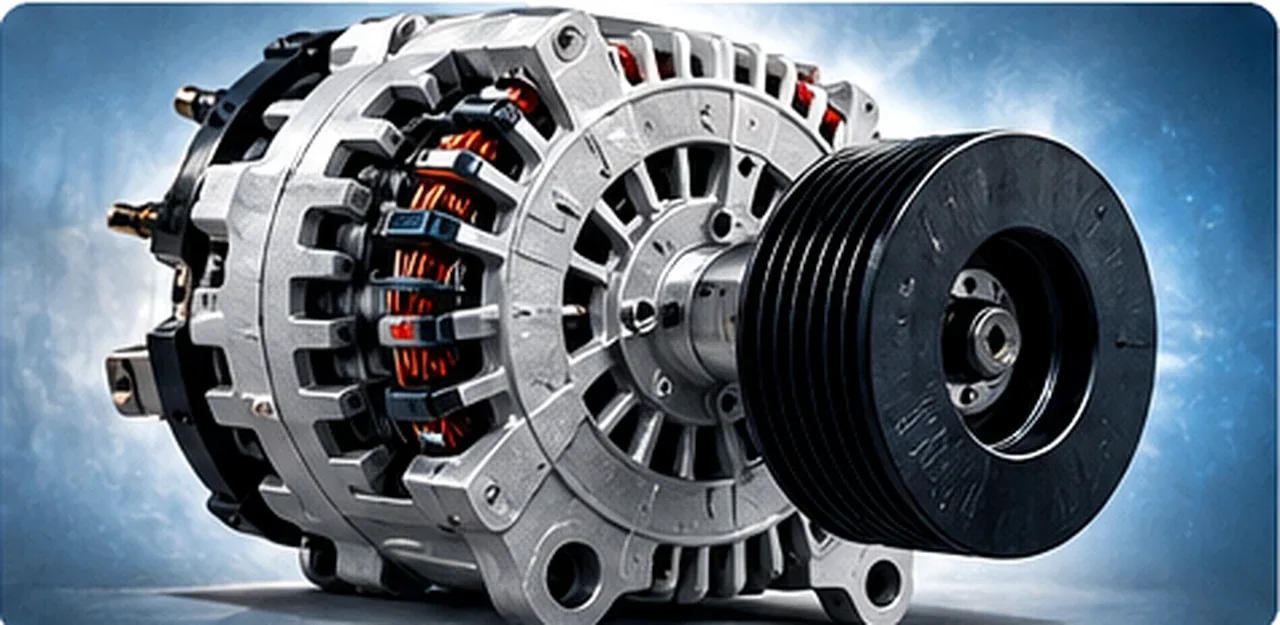
The battery light comes on while driving, the battery is flat every morning or a whine comes from the engine bay: the alternator is the first suspect. Yet a slipping belt, a worn battery, a corroded earth or a misread smart-charging strategy produce the same signs. Here is how to decide before buying, then how to choose the exact part number.
Key points
- Always test the battery before the alternator: a tired battery distorts every charging measurement.
- On a conventional 12 V system you will usually read between 13.5 and 14.8 V with the engine running; on a smart (ECU-controlled) alternator a lower value at times can be normal.
- The belt, tensioner and overrunning pulley are part of the diagnosis: a new alternator will not fix a slipping belt.
- To order, start from the number stamped on the original part and check voltage, amperage, pulley, mountings and regulation type.
How does an alternator work?
Driven by the accessory belt, the alternator turns part of the engine’s energy into electrical current. It powers the vehicle’s equipment and recharges the battery. Its regulator limits the voltage to protect the on-board network. On older vehicles this regulation is self-contained; on many recent vehicles it is commanded by the engine ECU (LIN bus or control signal), which lowers or raises the charge depending on temperature, battery condition and driving phase.
Which symptoms should raise the alarm?
Battery light on with the engine running
It indicates a fault in the charging circuit, not simply a battery to replace. The vehicle then runs on the battery’s reserve, loses its electrical functions and eventually stalls. Our guide battery light on while driving covers the possible causes.
Battery going flat despite regular driving
A battery that is often flat may be poorly charged, but it may also be drained by parasitic draw, very short trips or internal wear. A faulty alternator diode can also drain the battery overnight: see battery draining overnight.
Flickering lights, low-voltage warnings
Headlights that vary in brightness or cascading electronic warnings point to an unstable supply: regulator, poor earth contact or a battery at the end of its life.
Whining, rumbling or a hot smell
The noise may come from the belt, a pulley, the overrunning pulley or the alternator bearings. A burning smell means stopping safely. Never put your hand near a moving belt.
In which order should you diagnose?
- Battery at rest. With the engine off for a while, a charged 12 V battery shows about 12.6 V. Below 12.4 V, recharge it and have it load-tested before drawing any conclusion.
- Connections. Check the terminals, the engine earth and the alternator power cable (B+). A corroded connection creates a voltage drop that looks like a charging fault.
- Belt drive. With the engine off, check the condition and tension of the belt, the tensioner and the alternator pulley.
- Charging voltage. With the engine running, measure at the battery terminals at idle and then around 2,000 rpm, without and then with loads (headlights, blower, demister). The full method is in testing a 12 V alternator with a multimeter.
- ECU data. On a smart alternator, read the charging set-point and stored fault codes with a diagnostic tool: a low voltage may be intended by the charging strategy.
On a 24 V system (trucks, plant machinery) the values are roughly doubled, and charging at idle with heavy loads needs particular attention: see truck alternator and charging at idle.
Symptom, likely cause and check
| Symptom | Most likely cause | First check |
|---|---|---|
| Charging light on | Belt, alternator, regulator, wiring | Belt drive, then charging voltage |
| Battery often flat | Worn battery, weak charge, parasitic draw | Battery test, then charge and leakage current |
| Noise from the belt area | Pulley, overrunning pulley, bearing | Mechanical inspection with engine off |
| Voltage varies | Normal smart control or regulation fault | Read the ECU set-point |
| Voltage too high (above about 15 V on 12 V) | Faulty regulator | Prompt diagnosis to protect the battery |
Repair or replace the alternator?
The regulator, rectifier, brushes or bearings can be replaced on many models. When several parts are worn or the alternator has overheated, complete replacement is often safer and quicker. The guide repairing or replacing an alternator helps you decide.
How do you choose the right part number?
The vehicle model is not enough: the same engine may be fitted with several alternators depending on air conditioning, year, battery or electrical options. Proceed as follows:
- Note the number stamped on the original alternator (Bosch, Valeo, Denso, Mitsubishi Electric, Delco Remy, Prestolite…) and, if possible, the vehicle manufacturer’s number.
- Check the voltage: 12 V for cars, vans and most tractors; 24 V for trucks and many construction machines.
- Check the amperage: a 150 A unit does not automatically replace a 120 A one if the housing, pulley or regulation differ.
- Compare the pulley (diameter, number of grooves, overrunning or fixed) and the mountings.
- Identify the connector and regulation: conventional, ECU-controlled, LIN. A mistake here means a permanent warning light or incorrect charging.
A photo is a useful extra check, never proof of compatibility.
After fitting: the checks
Tighten the B+ cable to the specified torque, check the belt tension and test the charge with the engine running. On some vehicles a battery sensor (IBS) requires a procedure after the battery is replaced. If the light stays on with a new alternator, see new alternator not charging.
Frequently asked questions
Can you drive with a faulty alternator?
Only a few miles, on the battery’s reserve, with loads switched off. The vehicle will eventually stop, sometimes in a dangerous place: have it checked straight away.
Can a new battery hide a faulty alternator?
Yes, for a few days. If charging is insufficient, the new battery will go flat in turn. That is why you should measure the charge after any battery replacement.
Does a lithium battery change anything?
Yes: it can draw a very high current from the alternator and overheat it. In a campervan conversion, a DC-DC charger is recommended: see campervans and lithium batteries.
Find the right part
AutoTruck42 supplies new alternators with a 2-year warranty for every use. Have your original part number to hand and browse the relevant range:
- Alternators for cars and vans
- Alternators for IC-engine forklifts
- Marine alternators
- Alternator regulators and alternator spare parts
- All new alternators
Unsure about a cross-reference? Our technicians check compatibility from your original number before dispatch.
Further reading
Browse our catalogue of car and truck parts.