 Starter motor & alternator specialist
 Truck and van parts
 New parts with a 2-year warranty

 Contact an expert


Why a marine starter differs from an automotive one: corrosion resistance, insulated earth, ignition protection and standards. How to choose the right starter for a boat engine.
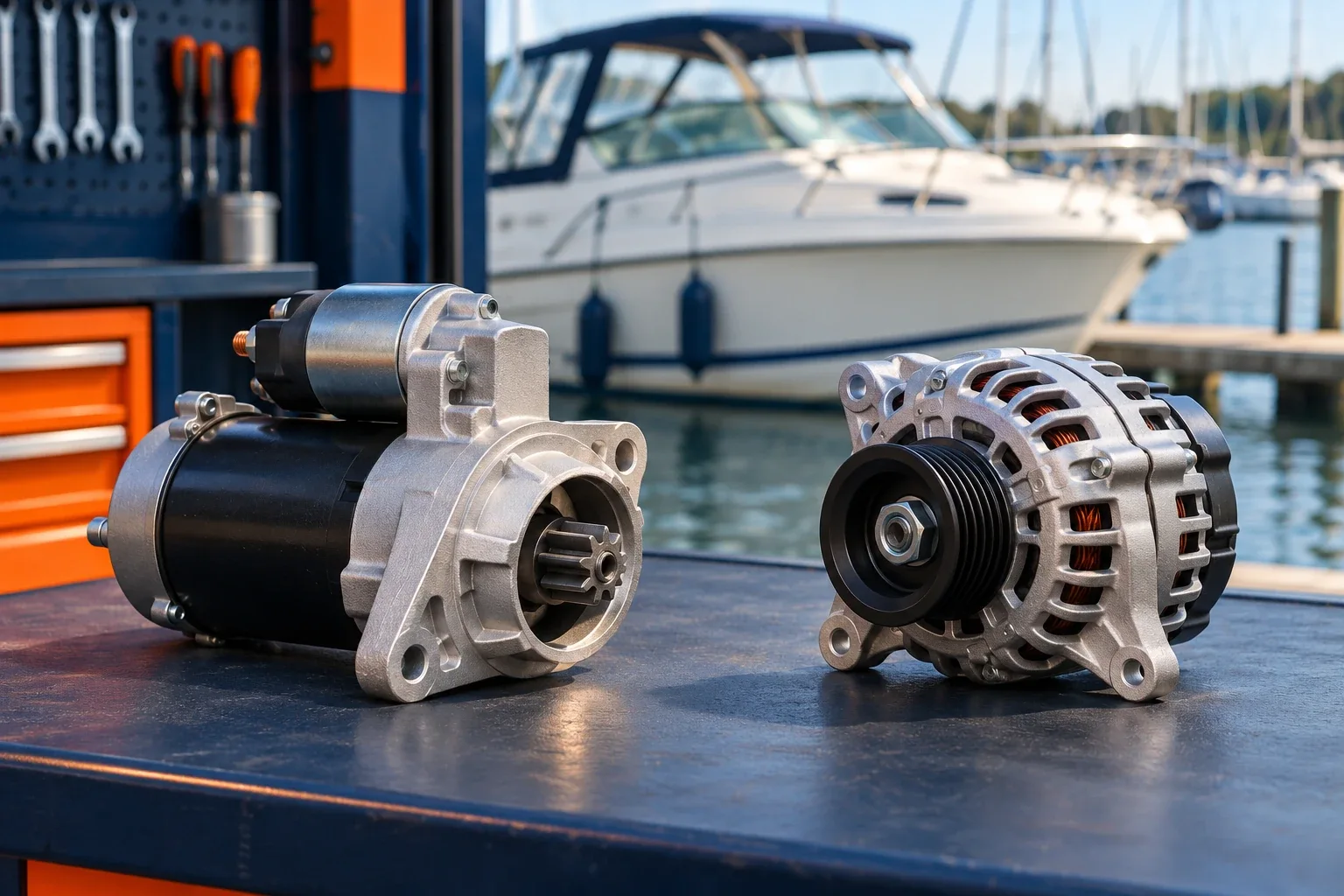
Many boat engines are derived from automotive or industrial engines, so their starter may look like a road model. Yet a marine starter is designed for a far more aggressive environment and must meet safety requirements specific to boats. Fitting an automotive starter instead leads to rapid corrosion and, in some cases, a fire risk.
Key points
- A marine starter receives reinforced anti-corrosion treatment against moisture and salt.
- On many engines it is insulated-earth: current returns through a dedicated cable, not the engine block.
- Petrol engines require an ignition-protected starter in an enclosed compartment.
- An automotive starter, even of identical size, generally lacks these features.
The main differences
| Feature | Automotive starter | Marine starter |
|---|---|---|
| Corrosion protection | Standard | Reinforced (treatments, seals) |
| Negative return | Through the housing and block | Often via an insulated terminal and cable |
| Ignition protection | Not provided | Provided on relevant models |
| Environment | Ventilated engine bay | Damp bilge, sometimes poorly ventilated |
Why insulated earth matters
On a boat, routing starting current through the engine block can encourage stray currents to the drive leg, propeller shaft or submerged metal parts, with a risk of galvanic corrosion. An insulated-earth starter returns current through a dedicated negative cable to the batteries. The same principle applies to the alternator: see insulated-earth marine alternator.
Ignition protection
In an enclosed engine compartment, petrol vapour can accumulate. A conventional starter can produce sparks at the brushes or solenoid. Marine starters intended for petrol engines are designed to limit this risk. On a diesel engine the requirement is less strict, but corrosion resistance and insulated earth remain important.
Choosing the right starter for a boat
- Note the original starter part number and the engine make, model and serial number.
- Check for an insulated negative terminal.
- Check voltage, power, pinion, direction of rotation and mounting.
- For a petrol engine, insist on an ignition-protected version.
- Prefer an identical marine part or a confirmed equivalent.
Maintaining a marine starter
Checks before and after winter lay-up are covered in diesel boat starter and winter lay-up. Charging engine and domestic batteries is explained in boat alternator and domestic batteries. If the starter clicks without turning, start with starter clicks but will not turn.
Frequently asked questions
My boat engine is car-derived, can I fit a car starter?
Mechanically perhaps, but it will not withstand the marine environment as well and may lack insulated earth and the required protection.
How do I know if my starter is insulated-earth?
It has a separate negative terminal cabled to the battery negative.
Is ignition protection mandatory?
It is required for electrical equipment on petrol engines installed in enclosed compartments. Check the regulations that apply to your boat.
Find the right part
AutoTruck42, a French company based in the Loire, supplies new marine starter motors and alternators with a 2-year warranty for boat engines:
Send us your starter part number or the engine make, model and serial number: we check compatibility before dispatch.
Browse our catalogue of car and truck parts.