 Starter motor & alternator specialist
 Truck and van parts
 New parts with a 2-year warranty

 Contact an expert


Protecting the starter of a diesel boat engine during winter lay-up and checking it before relaunch: batteries, connections, corrosion, pinion and cranking tests.
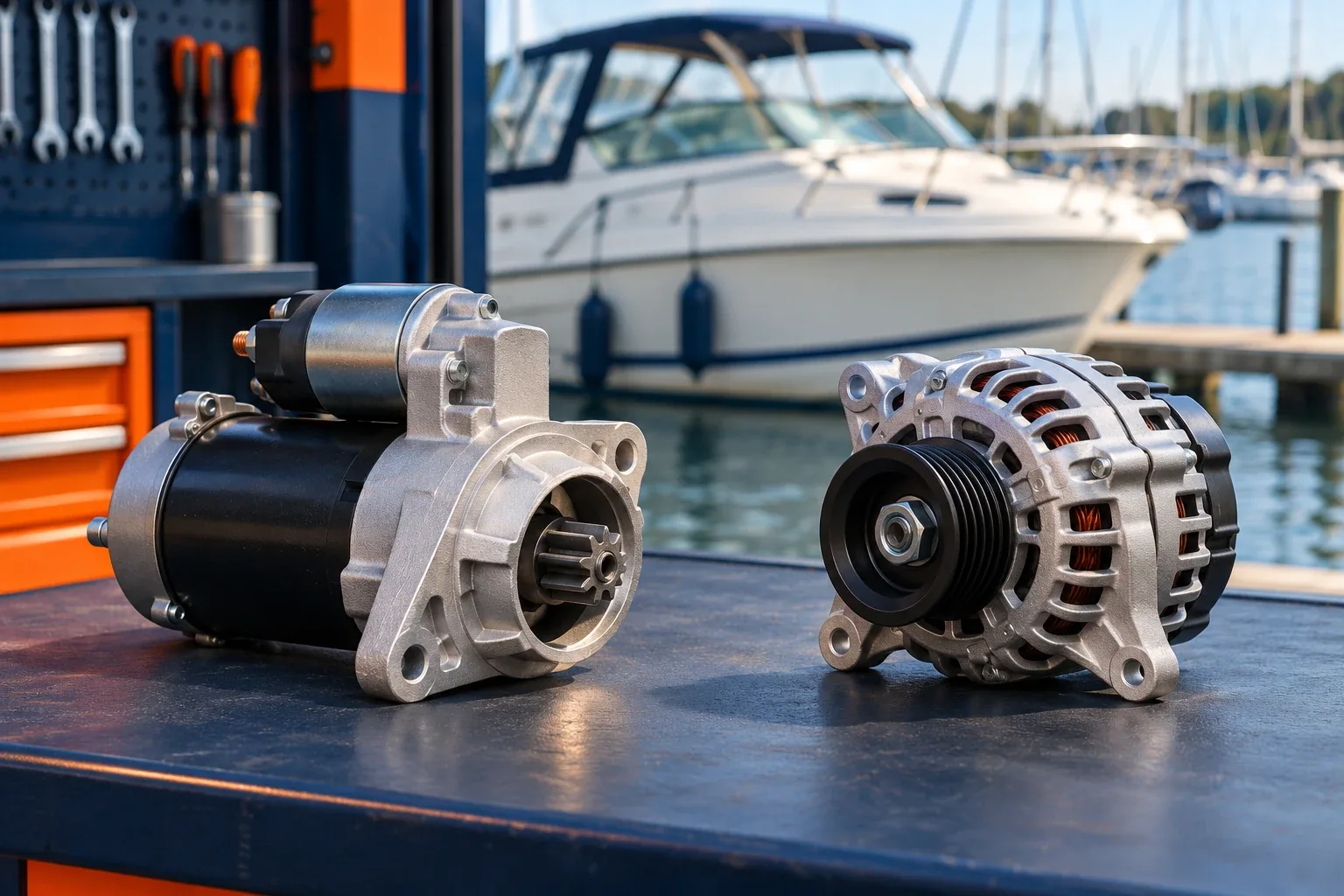
On a boat, the starter lives in a damp, salty environment, often at the bottom of a poorly ventilated bilge. During winter lay-up it does not turn for months: corrosion sets in on the terminals, pinion and connections. A few precautions before winter and a series of checks in spring avoid the unpleasant surprise of an engine that will not start when it is time to leave.
Key points
- Moisture and salt attack the starter’s terminals, solenoid and pinion during the winter shutdown.
- Batteries that are charged and disconnected, or kept on maintenance charge, avoid deep discharge.
- Dielectric grease on connections limits corrosion.
- In spring, check voltage, voltage drops and cranking noise before launching.
Before winter: preparing the starter and batteries
- Fully charge the batteries, then disconnect them or connect a suitable maintenance charger.
- Clean battery and starter terminals, then protect them with dielectric grease.
- Check the cables: cracked sheath, green or whitish terminals.
- Check the bilge is watertight to limit standing water under the engine.
- Do a final start test and note any abnormal noise.
In spring: checks before relaunching
- Measure each battery at rest: 12.6 V when charged.
- While cranking, voltage should not drop below 9.6 V on 12 V.
- Measure voltage on the starter’s main terminal during the attempt: the difference from the battery should stay small.
- Listen while cranking: grinding or whining points to the pinion or ring gear.
- Inspect the starter: traces of rust, salt or water runs on the housing.
Typical spring faults
| Symptom | Likely cause |
|---|---|
| Click without rotation | Flat battery, corroded terminal, seized solenoid |
| Slow cranking | Weak battery, corroded cables or earth |
| Starter spinning freely | Pinion seized by corrosion |
| No sound | Battery isolator, fuse, relay, switch |
| Starter overheating | Seized bushes, armature rubbing |
Marine or automotive starter?
A marine starter is designed to withstand moisture and salt and, on many engines, is insulated-earth and ignition-protected. Fitting an automotive starter instead may seem possible, but it will age very quickly and can create a safety issue. The difference is detailed in marine or automotive starter.
The onboard alternator and batteries
Charging the engine and domestic batteries is explained in boat alternator and domestic batteries. For insulated-earth engines: insulated-earth marine alternator. If the starter clicks without turning, the general diagnostic method is in starter clicks but will not turn.
Frequently asked questions
Should the starter be removed for winter?
No. Just protect the connections, keep the batteries charged and limit moisture in the bilge.
My boat starter will not turn after winter, is it finished?
Not necessarily: first check battery charge and terminal condition. A seized pinion can also block cranking.
Can a marine starter be replaced with an automotive model?
Not recommended: it is not designed for moisture and salt and does not always offer insulated earth or ignition protection.
Find the right part
AutoTruck42, a French company based in the Loire, supplies new marine starter motors and alternators with a 2-year warranty for boat engines:
Send us your starter part number or the engine make, model and serial number: we check compatibility before dispatch.
Browse our catalogue of car and truck parts.